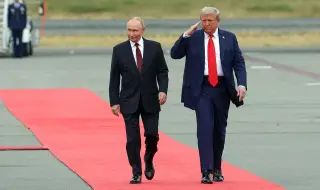
In a historic week in which the whole world was waiting for the meeting between Putin and Trump in Alaska, the long history of Soviet diplomacy can help us understand how to negotiate with Putin.
To this end, the French online publication Le Grand Continent analyzes an article by Russian writer and journalist Leonid Mlechin, taken from the biography of former Foreign Minister Yevgeny Primakov, perhaps the most influential figure in understanding Russian geopolitics from the Yeltsin era to Putin.
In this article, Mlechin analyzes the evolution of Soviet diplomacy through the prism of several figures, from Trotsky to Gromyko, focusing on the negotiation styles and strategies of each of them, using several confidential sources. From it we understand that the negotiation tactics of Putin and Lavrov are the result of a vision of diplomacy diametrically opposed to the image we have in Europe. Its creator is the man called "Stalin's Hammer" - Vyacheslav Molotov.
It is in this text that we find the most complete formulation of the "Gromyko Doctrine": "First, demand the maximum and do not hesitate to exaggerate your demands. Demand even what never belonged to you. Second, issue ultimatums. Threaten war, do not spare the threats, then offer negotiations as a way out of the situation: there will always be people in the West who will take the bait. Third, once the negotiations begin, do not give in an inch. Your interlocutors will eventually offer you part of what you asked for. But even then, do not sign: insist on more and they will accept. When you have received half or two-thirds of what never belonged to you, you can consider yourself a diplomat."
The current High Representative Kaia Kallas repeated this two years ago at the Munich Conference, establishing a direct continuity between Gromyko's method and Putin's.
Trotsky, Stalin and the Soviet School of Diplomacy
According to Trotsky, the world proletariat did not need diplomacy: the workers would understand each other directly, without intermediaries. Leon Davidovich especially hated secret diplomacy. After him, the habit of secretly concluding an agreement while publicly declaring the opposite was established.
Appointed People's Commissar for Foreign Affairs, Trotsky intended to dismantle the diplomatic and military order of the old regime. Therefore, he published in "Pravda" several secret treaties concluded by Tsarist Russia to expose imperialist diplomacy and provoke an international scandal, hoping for a world revolution.
During the negotiations in Brest-Litovsk (between 1917 and 1918), Leon Trotsky, who headed the Soviet delegation, used an unconventional and deliberately provocative tactic: he refused to sign any treaty, proclaiming a state of affairs defined as "neither war nor peace", which, in his opinion, would provoke a revolution in Europe. This decision failed and Trotsky's position was completely turned upside down by Stalin.
Stalin admired the British diplomatic style, but considered it nothing more than the art of deception brought to the highest degree of perfection: "The words of a diplomat should have no connection with his deeds, otherwise what kind of diplomacy is this? Words are one thing, deeds are another... Sincere diplomacy is as impossible as dry water or iron wood."
This quote is taken from an article by Joseph Vissarionovich Dzhugashvili, published in issue 30 of the newspaper "Sotsialdemokrat" on January 12, 1913, as well as in Stalin's collected works.
In it, the red tyrant attacks bourgeois diplomacy and its duplicity: "When bourgeois diplomats prepare for war, they begin to loudly proclaim peace and friendly relations. If any foreign minister starts to spread turds about a "peace conference", know that his government has already ordered new battleships and monoplanes.
In this way, the Stalinist style of negotiation imitates what it claims to be fighting, while at the same time disguising its intentions. To implement this method, he relied on the most experienced and cunning advisor: Vyacheslav Molotov (1890-1986), who invented what Soviet diplomacy would become until the collapse of the USSR.
Molotov and the Birth of the Soviet School of Negotiation
The Soviet school of negotiation was founded by Vyacheslav Molotov. He was not a diplomat in the traditional sense of the word: he did not seek to charm his interlocutors, nor to make friends or allies. Stubborn and meticulous, he negotiated with firmness and inflexibility. He said what he considered necessary, and when his interlocutors objected, he tirelessly repeated the same thing, like a gramophone, until he drove them crazy. He displayed extraordinary tenacity, ready to defend his position until he was completely exhausted.
Only after trying everything - including threats to break off negotiations - did he agree to a concession.
A veteran of Soviet diplomacy, Molotov - "Aunt Molly", as British diplomats eventually called him, was also called "The Hammer" - a reference to the sound of his name: in Russian "hammer" is molotok. His methods of destabilization most often consist of endlessly repeating the same questions, interrupting the discussion, or even constantly postponing the meeting in order to break up the interlocutors.
This is exactly what he does with Georges Bidot, who is trying to impose the presence of France at the Potsdam Conference. As reported by US Secretary of State John Foster Dulles: "Molotov's goal was to make Bidot leave the conference. To this end, Molotov tried to damage the honor of France with a series of petty, disparaging remarks. He also occasionally asked for postponements without informing Bidot. The latter, who arrives exactly at the appointed time, waits with increasing impatience for his colleagues to appear before returning to his hotel. Several times he was on the verge of returning to Paris."
In his memoirs ("War or Peace", 1957), Dulles himself tells how Stalin's man managed to penetrate the personality of the British Foreign Secretary Ernest Bevin. Bevin, Dulles writes, "bluffed but was warm, exploded but quickly repented". Molotov treated him like a matador with a bull, throwing a series of spears to provoke him until he exploded. At one point, Bevin became so angry that he finally said that Molotov spoke like Hitler... Molotov jumped up and headed for the door. Bevin, repentant, hastened to explain his harsh words and, as a sign of sincerity, gave way on the controversial issue."
This intransigence and refusal to reconsider one's positions may seem like virtues. In politics, however, they often caused harm to the country, since they met with the same firmness on the opposite side. Thus, in Washington, Molotov found opponents who did not yield to him in stubbornness.
Between 1928 and 1953, Molotov attended more than 2,000 meetings in the Soviet leader's private office. Although he brilliantly coped with his role as Stalin's number two (he fell out of favor with Khrushchev and died in 1986), his brutal negotiating style was used primarily to push an ideological project that can be traced back to Putin and Surkov. In his 1946 book "Problems of Foreign Policy" he wrote that "it is sometimes difficult to distinguish between the desire for security and the desire for expansion". As one of the leading historians of the period, Geoffrey Roberts, quoting the British diplomat Sir William Seeds, says, Molotov, who spoke no language other than Russian, was a man "to whom the very idea of negotiation - as opposed to the mere imposition of the will of his party leader - was completely alien". However, when confronted, especially at the Yalta, Washington and Dumbarton Oaks conferences in 1944, his American interlocutors - Cordell Hull and later Edward Stettinius - showed a similar determination, which limited the effectiveness of this tactic of attrition. The impact of the Stalin-Molotov style on the Soviet Foreign Ministry and diplomatic network was profound. As historian Sabine Dulin argues, this strategy led to a depletion of expertise: "Neither Stalin nor Molotov intended to leave their ambassadors much room for maneuver, nor did they trust positions that experienced diplomats of the previous period, who had served during the war and in the Grand Alliance, considered "opportunistic." Towards the end of his life, Molotov, aware of the generally low level of Soviet diplomats abroad, attributed it to their inexperience: in fact, this was a consequence, not a cause, of this policy.
The Shepilov-Vyshinsky Interregnum
Foreign diplomats did not trust Andrei Vyshinsky. They knew that no agreement was possible with him and that no compromise was achievable. Vyshinsky did not even try to persuade his interlocutors to accept the Soviet proposals: he simply showered them with insults and curses.
A staunch Stalinist loyalist - famous for having been Prosecutor General during the Great Purge - Andrei Vyshinsky was the USSR's Foreign Minister from 1949 to 1953, before being appointed the Soviet Union's permanent representative to the UN Security Council.
Vyshinsky was no stranger to tirades against the United States, especially from the podium of the then-young UN General Assembly, which was meeting in Paris. He introduced a brutal practice of direct insults to the international arena of the post-World War II order. Addressing directly the American delegates Eleanor Roosevelt, John Foster Dulles, Warren Austin and George Marshall, Vyshinsky accused the United States of preparing for a nuclear war against the Soviet Union.
Dmitry Shepilov, younger, open and far from rigid, knew how to listen to his interlocutor and when he considered his arguments reasonable, agreed with him. Foreign diplomats, accustomed to Molotov and Vyshinsky, were surprised to meet a "normal" person.
Dmitri Shepilov was the Minister of Foreign Affairs of the Soviet Union between 1956 and 1957. While Molotov held the post for a few years after Stalin's death, Khrushchev took advantage of the Suez Crisis to remove him.
He is known for being the author of the "Shepilov Plan" in response to Eisenhower's Middle East doctrine. As Mlechin suggests, he was primarily a transitional minister, designed to mark a break with the Molotov method.
Gromyko - Consolidator of the Molotov School
Gromyko was trained in the Molotov school. In rare moments of frankness, he gave advice to his young assistants. One of them, Oleg Alekseevich Grinevsky, wrote it down: "First, demand the maximum and do not hesitate to exaggerate your demands. Demand even what never belonged to you. Second, issue ultimatums. Threaten war, do not spare threats, then offer negotiations as a way out of the situation: there will always be people in the West who will take the bait. Third, once negotiations begin, do not give up an inch. Your interlocutors will eventually offer you part of what you asked for. But even then, do not sign: insist on more and they will accept. When you have received half or two-thirds of what never belonged to you, you can consider yourself a diplomat."
Based on threats and the firm belief that the West always gives in eventually, Gromyko's negotiation tactics, perfecting and theorizing Molotov's practice, are based primarily on the third point: never give in on any issue.
With regard to Ukraine, contrary to the claims of the American administration and despite the apparent entry into "negotiations", Putin's Russia has never changed its line: it demands Ukraine's capitulation and the beheading of its sovereign power. That is why Volodymyr Zelenskyy again stated on August 11 that, in his opinion, no concessions would probably force Vladimir Putin to back down.
Here are the recommendations Gromyko Sr. gives his son when he goes to work abroad:
"In a group, treat everyone equally - don't stand out, be modest. Listen more than you talk. It is important to listen to the other person, not yourself. If you are not sure whether to speak, it is better to remain silent. And most importantly - do not make friends with foreigners: for politicians and diplomats they are an unnecessary burden. ”
Called "Mr. No", like Molotov, Gromyko embodied the ideal of a Soviet diplomat, which is diametrically opposed to European traditions - for example, the French or British - where diplomacy is synonymous with etiquette, knowledge of the world, connections, etc.
As Sabine Dulin summarizes: "Molotov's method of conducting foreign policy does not require such a deep understanding of the other side's way of thinking as in the previous period. Moreover, most often it is not a question of invading the enemy's territory, but of consolidating the position and forcing the enemy to take your side. In the post-war environment, the presence of diplomats who were poorly acquainted with the outside world, immune to its charms by a rigorous political education and therefore immune to influence, could be a valuable asset in Cold War diplomacy."
Gromyko was superior to Molotov in skill, which was recognized even by such a shrewd observer as former US Secretary of State Henry Kissinger. According to him, Gromyko did not believe in sudden insights or cunning maneuvers: this contradicted his innate prudence. Tireless and imperturbable, he only got angry on purpose. He never entered into negotiations without studying the case: to have a discussion with him without carefully studying the documents was tantamount to suicide, Kissinger admitted.
Henry Kissinger dedicated a major speech to Gromyko on the occasion of his centenary in 2009 - also calling him "friend" - in which he praised the Soviet diplomat's intelligence and efficiency: "Andrey Gromyko gave the impression of a very strict, very professional, very correct man, and that was indeed true. But I would like to add that he was also very intelligent, always well prepared and never lost his composure. He had a wonderful sense of humor, which was not immediately apparent, but once we got to know him better, it was a great help in our conversations."
In the same speech, he admitted that Gromyko sometimes had difficulty changing his previously unwavering position: "When he was ordered to change his position, it was obvious that it made him feel uncomfortable."
Gromyko attached great importance to preparatory work - he personally collected the necessary documentation so that it was ready at the moment. He was not afraid of the dirty work, which often allowed him to dominate less prepared diplomats. He left no room for improvisation, although it was an integral part of diplomacy, since at the height of the Cold War it could be dangerous. He could negotiate for hours without forgetting anything, retaining almost everything in his memory: only the flow of technical data forced him to turn to his notes. Although he spoke fluent English, he always required translation: while the translator spoke, he gained valuable time to think about his answer.
With infinite patience, Gromyko sought to exhaust his interlocutors, bargaining for every point. He counted on their impatience and did not give in until they were ready to give in. He knew how to exchange small concessions for significant compensation and was even more inflexible because he wanted to appear less eager to reach an agreement than his American partners.
As in poker, he always started with a firm position, then listed the demands that Washington considered excessive before praising the patience and generosity of his own government: a kind of ritual opening. Thus the negotiations became a test of endurance. In the end, he would subtly reformulate the opposing position, bringing it closer to his own, in order to set a precedent for the next meeting.
Over time, however, this tactic backfired: his foreign partners realized that if they remained firm, they could force him to make concessions. Fearing that the negotiations would drag on or break down at the last minute, he sometimes signed too quickly, for fear of having to answer to the Politburo for failure.
He never took the initiative without instructions, and even when they provided an opportunity for compromise, he did not want to use them. This firmness sometimes caused him to miss opportunities to secure favorable terms. He could also cling to unrealistic promises to Brezhnev that he would have to sacrifice essential things to save the agreement. As former ambassador Valentin Fallin wrote, "when pressed - often alone - he did not consider it beneath his dignity to sacrifice fundamental values". In pursuit of small gains, he sometimes lost major things.
Despite the formal and tactical continuity from Molotov to Putin, via Gromyko, the analysis should not ignore what remains a fundamental difference between the Soviet period and the Russian Federation under Putinism.
As Mlechin notes at the end of this text, the inflexibility and steadfastness that eventually became the doctrine of USSR diplomacy can be partly explained by a highly hierarchical system, certainly centered on the figure of the Supreme Soviet, but after Stalin's death, also dependent on an administrative and bureaucratic logic with a strong inertial effect.
Putin's diplomacy, led by Lavrov and Patrushev - who prophesied in early 2025 that "Ukraine may cease to exist this year" - can use this intransigence even more effectively because it focuses on a single issue and responds to a single desire: Vladimir Putin's desire to expand Russia's territory.