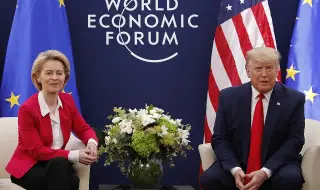
After the agreement signed with the United States by Donald Trump on July 27 in Scotland, Europe is entering its "century of humiliation". This is what the economic journalist and columnist for TF1-LCI and RTL François Langlé claims in an interview with the French daily Le Figaro.
LE FIGARO: As part of the agreement with Trump, the European Union agreed to impose tariffs of up to 15% on almost all its exports to the United States and neither receives anything in return nor imposes counter-sanctions. Was any other result possible?
FRANCOIS LANGLE: No, this agreement is anything but surprising. It embodies the balance of power between Trump's America and Europe: all for me, the rest for you. This is a consequence of the new role that the United States occupies in world affairs, the "rebellious superpower", in the words of the American academic Michael Buckley. That is, the number one power that has no other ambition than to strengthen itself at the expense of others, starting with its former allies - they are the ones who offer the best return on blackmail, because they are weak. The most striking thing about this affair is that the European Union is happy. Humiliated and satisfied. Although, in addition to tariffs, Brussels is trampling on its own policies to please Trump.
Thus, he agreed to invest 600 billion in America, while the outflow of investment is precisely the main problem highlighted by the Draghi report... He committed to buying American weapons, while calling on member states to strengthen their defense industrial base...
He committed to buying trucks with American gas while working towards zero carbon emissions! As for the supposed "predictability" offered by the exporters' agreement, this is complete nonsense. A person sentenced to ten years in prison can obviously congratulate himself on the predictability of his living conditions for the next decade.
LE FIGARO: London has received from the White House the lowest possible tariff rate to date (10%). Does this "victory" to discredit the European Union?
FR. LANGLE: The US trade with the United Kingdom is not in deficit, which could explain the more favorable treatment that London has received. In the hierarchy of kingdoms dependent on the American empire, we occupy an intermediate position between the United Kingdom, which is doing better, and Japan, from which Trump received the payment of several hundred billion directly to the American treasury. And all those who are now threatened with a 30% or 40% hit if they do not reach an agreement this week.
LE FIGARO: Can the fact that the European Union is not in a strong position be explained by the fact that it does not control any of its strategic positions on the scale of the global economy?
FR. LANGLE: Yes, without a doubt. It must be remembered that the European Union was not created to exert influence on the world stage. The main purpose of the Brussels Commission is to monitor the Member States to ensure that they comply with the rules of the single market and competition. Brussels was created to eliminate borders and economic nationalism within the Union. The construction of this single market was also a useful preparatory step for mastering globalisation, especially for France and its bureaucracy.
But times are changing. Globalisation is changing in its nature and scope; it is fragmenting due to the reorientation of the dominant power towards its exclusive interests at the expense of the world order. Globalisation is impossible without a self-proclaimed master of the world. The Commission would therefore have to rely on borders and practice a kind of European nationalism to protect the Member States in the great confrontation between empires. It is unable to do so, because that would require abandoning the Treaties. That is why it is running around like a headless duck, disoriented by the disappearance of yesterday's world.
A strong Europe is a chimera, maintained by federalists who still want to save their dream. This is the last stage of denial before accepting reality: Europe is entering its "century of humiliation", like China in 1842, after the Opium War. Trump, just like the British of that time, is forcing our ports to open. With these agreements, Europe signed the Treaty of Nanjing, which subordinated the Celestial Empire to British commercial interests.
But in Brussels's defense, it must be said that the problem is more serious than the Commission itself. It is the citizens themselves who are resisting the power and the sacrifices it would demand of them. "We are not afraid", declared Emmanuel Macron immediately after the signing of this surrender agreement. The problem with being afraid, of course, is that you have the means of revenge, but above all it depends on whether you have the will to use them.
Brussels spent weeks developing punitive countermeasures for the United States, explaining that we will not use them... The bureaucrats invented the commercial version of the cap gun. Worse still, French officials explained on the eve of the agreement that there would be no retaliatory tariffs because economists had calculated that they would be harmful to our consumers!
LE FIGARO: Isn't Trump's main aim with these tariffs to move production to the United States?
FR. LANGLE: Yes, he wants to weaken global growth. He rejects the position of "consumer of last resort" that has always been held by the masters of the world - the United States in the 20th century, Britain in the 19th. On the contrary, he wants to reindustrialize his country. That is why he wants tariffs and a weak dollar to encourage manufacturers from all over the world to set up shop in the United States. He will not stop there. These tariffs will be used to force partners to revalue their currencies or to finance US debt for free, with the famous zero-coupon bonds advocated by one of Trump's inspirations, Stephen Miran.
The other goal is, of course, budgetary. The tariffs will fill Washington's coffers. The agreement with Europe alone could provide it with an additional hundred billion dollars a year. This is necessary to finance the "Big and Beautiful Budget" - the tax breaks passed by Congress last month. In both cases, it is a predatory strategy: America drains investment to water its soil and the financial resources of other countries to redistribute them to its companies in the form of tax breaks.
LE FIGARO: Are we not overestimating Trump's victory? European commitments to purchases and investments have no other value than political...
FR. LANGLE: It is true that the figures are so crazy that they are not credible. Ursula von der Leyen has committed to purchasing liquefied gas for 250 billion euros per year, while we, for the whole of Europe, are currently below 100 billion euros... But this still creates pressure for the coming years and this is undoubtedly the aim of the American negotiators.
However unreasonable they may be, these amounts have clearly been accepted by Europe. And beyond the considerations of numbers, there is a lesson to be learned: access to international markets has a price, because it has a value. And this price has been rising since the election of Trump. Europe should therefore think about the price of access to its own market, one of the largest in the world, and about how to negotiate future trade agreements.
LE FIGARO: What can we expect specifically in terms of trade?
FR. LANGLE: The question is who will pay the tariffs. It is logical that the American consumer will face higher prices for imported goods. Not by 15%, because distribution costs represent up to a third of the final price. In reality, each of the participants in the trade chain - exporter, carrier, importer, distributor and consumer - will be under pressure to reduce their margins or pay a little more.
The distribution of these efforts will vary depending on the balance of power in the market, which varies significantly depending on the sector. All this should reduce trade flows to America. However, the impact on growth in France will be less severe than in Germany and Italy, which are more export-oriented, as is already evident from the data for the second quarter of 2025.
LE FIGARO: Which sectors will be most affected?
FR. LANGLET: Companies that produce luxury goods can withstand both price increases and a contraction in their margins, which are significant. On the other hand, for dairy products and cheese, one of our main exports, consumers will be less willing to pay. Exporters will have to absorb the capital loss if they do not want to lose market share. The same applies to cosmetics, which is also one of our export strengths.
The high-end will survive thanks to the strength of brands and the "made in France" image, but mass-market products, which are more price-sensitive, are expected to suffer. The automotive industry is only indirectly affected, since we do not export French cars across the Atlantic. However, French equipment manufacturers, subcontractors of European manufacturers, could suffer from the pressure on German exporters.
In all these areas, manufacturers will try to produce more in the United States to avoid taxes. This could lead to a new wave of offshoring. Finally, some sectors, such as the pharmaceutical industry, remain in limbo because their customs regime has not yet been determined.
LE FIGARO: Can we now expect the marginalization of the European Commission? Will von der Leyen become the friend that member states no longer accept?
FR. LANGLET: Trade issues have always divided Europe, both between member states that do not share the same interests and between sectors within the same country. This time, however, the continent is not truly divided; it is divided between resigned losers and relieved losers. Relieved because they feared worse - Trump's strength is that he softened the deal during the negotiations after threatening even tougher punitive tariffs.
Beyond grumbling, there is no real desire to challenge the agreement approved by the Commission President. Moreover, several of the United States' trading partners have already swallowed their pills: Japan, South Korea and everyone waiting in the corridors of the White House...
China is now the only one standing up to America. Let's hope that this affair will at least have revealed to Europe, its citizens and its leaders the scale of the changes taking place in international relations. In the escalating confrontation, everything is strategic, including trade issues. Everything has a price. Everything is a lever for gaining influence or resources.
This requires our own revolution in ideology and action, after forty years in which free trade was considered the natural state of international relations, regardless of political issues and beneficial to all. Trade is returning to its place, subordinate to political goals. In this sense, Trump teaches us a painful but very useful lesson.
To use the aphorism of the economist Marc de Sitivu, in the long history of kicking ass, the foot is not always the most guilty.