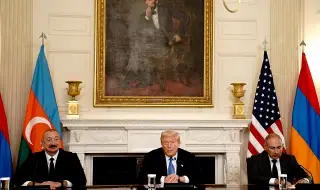
This was far from the first handshake between the Armenian Prime Minister and the Azerbaijani President that the current 2025 witnessed. The two also did so at their meeting in Tirana, and then in Abu Dhabi.
But this time it was a huge handshake, marking the signing of a big and great declaration.
A handshake that bore the large-scale characteristics of their host, Donald Trump, before whose gaze Nikol Pashinyan and Ilham Aliyev agreed to make additional efforts to conclude a final truce between their countries. And Armenia and the United States, together with interested "third parties", have committed to building the "Trump Route for International Peace and Prosperity" (TRIPP). Or what the media is already calling the "Trump Bridge".
This trilateral meeting "builds" on the progress in the negotiations between Armenia and Azerbaijan this year. Diplomatic talks between Yerevan and Baku aim to resolve the consequences of the Nagorno-Karabakh conflict, which ended with the absorption of the aforementioned territory into the borders of Azerbaijan in 2023.
Despite the diplomatic progress we have witnessed this year, one of the still unresolved issues between Armenia and Azerbaijan is the conditions under which the construction of the Zangezur corridor should proceed.
This corridor aims, firstly, to connect Azerbaijan with the Azerbaijani enclave of Nakhichevan through Armenian territory on the border with Iran, and, secondly, to integrate this artery into the Middle Corridor connecting Turkey and China through Central Asia.
The disputes between Yerevan and Baku over this corridor consist in the fact that the two capitals do not have the same understanding under whose sovereignty this trade and road artery should be. The question of ownership of the infrastructure in question - which will consist mainly of a railway and a highway - is relevant to a number of subsequent questions.
For example, who will finance the project in question, who will guard it, who will determine the regime of its regulations in general. Or if we were to reduce these questions to a more prosaic interpretation, the question is the following: will the Armenian authorities have the right to impose transit fees on passing Azerbaijani trucks and carry out inspections of their cargo? And under what regime will the Armenian-Iranian border checkpoints continue to function there?
Being in the weaker negotiating position, back in time Armenia proposed the following: whatever regulation is introduced in the administration and management of this corridor, the same rules should apply to the road infrastructure of Nakhchivan. That is, if Azerbaijani trucks will be able to pass freely through Armenian territory - without paying taxes and being subject to inspections, then Armenian trucks will also enjoy the same privileges when passing through the Azerbaijani enclave in question. Baku did not react with any enthusiasm to this proposal from Yerevan.
The declaration that Trump, Pashinyan and Aliyev signed in Washington does not necessarily provide an answer to these questions. In fact, the document, in which the Zangezur corridor is euphoniously called "Trump Bridge", is ambiguous.
On the one hand, the declaration states that Azerbaijan should have "unhindered" access to Nakhichevan through Armenian territory. On the other hand, however, this should be done on the basis of Armenia's jurisdiction and with "reciprocal benefits" for Yerevan. What kind of Armenian jurisdiction and benefits (taxes) are we talking about when Azerbaijan will have the right to free transit? And how will Baku be able to count on unhindered access through the Zangezur corridor when Armenia will have the right to impose the entire toolkit of its jurisdiction?
The spirit of the declaration is designed in the style of "both the wolf is full and the lamb whole", so that its text can serve as an occasion for a "PR-happening" of the White House. The man who is driving these negotiations from the American side, Steve Witkow, is already failing in his other diplomatic efforts aimed at ending the wars in Ukraine and Gaza. The latter tells us why Washington wants to capitalize on the progress in the bilateral negotiations between Yerevan and Baku: Donald Trump has a glaring need to show that his diplomacy for resolving conflicts can also yield positive results.
Despite the risk that the "Trump Bridge" will remain a paper project due to the existing contradictions in the declaration signed in Washington, it should not be underestimated. Moreover, the document in question may prove to be a really good basis not only for the final truce between Armenia and Azerbaijan, but also for the "unblocking" of the economic arteries of the South Caucasus.
The latter would be of the greatest benefit to Armenia, since due to the conflict in Nagorno-Karabakh, the country has closed borders with Turkey and Azerbaijan. Opening these borders would mean diversification of Yerevan's trade relations and less dependence of the country on Russia and Iran.
If it comes to its implementation, the "Trump Bridge" will place Armenia on the route of the aforementioned Middle Corridor, through which part of the trade between Europe and China will still pass through Turkey and Azerbaijan.
It remains to be seen whether the "inclusion" of the Americans in this project will enable Armenia to reduce the strong Turkish pressure, through which Baku and Ankara simply wanted to expropriate the Zangezur corridor in one form or another. However, the Americans do not give "firm" guarantees to Armenia, but rather point to their economic participation in the project as a form of security.
Laying the foundations for building strategic relations with the US will allow Azerbaijan to have greater geopolitical resistance and flexibility, especially against the backdrop of the complicated relations between Baku and Moscow since the end of last year.
It is Azerbaijan that remains the main "third country", along with Turkey, that can participate in the construction of the "Trump Bridge" through Armenian territory, thus guaranteeing its long-standing priority for the country's logistical connection with Nakhichevan.
Azerbaijan will thus become the intersection of two economic arteries - the North-South International Transport Corridor, connecting Russia with India, and the Middle Corridor, located between Europe and China.
Both Armenia and Azerbaijan - especially considering their increasingly difficult bilateral relations with Moscow - would see American participation in the construction of transport and trade routes in the South Caucasus as an opportunity to reduce Russian influence in the region.
Here is the moment to recall that it was Russia that was the main mediator between Yerevan and Baku during the Nagorno-Karabakh war, and the agreement concluded to end it envisaged Moscow playing the role of guarantor and security donor in the implementation of the Zangezur corridor.
Instead, however, the declaration signed in Washington assumes its construction with American assistance (although still unclear what, especially considering that before the trilateral meeting in question, there was a lot of talk in the White House that Armenia would give exclusive rights for many years to the Americans to develop this project).
Along with Russia, the other party that will feel harmed if the "Trump Bridge" is implemented is Iran. Tehran has always been against the influence of countries that are not part of the region on the South Caucasus. The implementation of a project in which the Americans will participate, on the border of Iran with Armenia, is a further horror for the ayatollahs' regime, after it is already facing the ever-deepening partnership between Azerbaijan and Israel again in the South Caucasus.
"Trump Bridge" is an exotic formulation that relies on the progress in bilateral negotiations between Armenia and Azerbaijan, the easing of Armenian-Turkish relations and the deterioration of those between Armenia and Azerbaijan, on the one hand, and Russia, on the other.
The document itself, containing internal contradictions, is more for advertising purposes. But it still expresses an intention, the implementation of which will require subsequent and coordinated efforts.
The shared interests between Armenia and Azerbaijan should be one of the main supporting pillars that will support the structure of economic integration of the South Caucasus. Moreover, this is not about just any facility, but about a large, huge and great bridge.