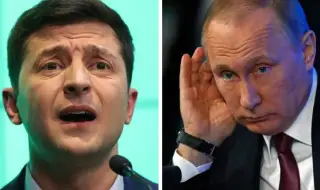
Russian bombing in Ukraine is not decreasing, but rather intensifying. While Putin believes that he can terrorize Ukrainians with impunity, there will be no personal meeting with Zelensky. Comment by Ivan Preobrazhensky.
Sources from Donald Trump's entourage say that the president is disappointed. The Americans were not prepared for Sergey Lavrov's statements during the meeting with the Indian Foreign Minister that the talks between Putin and Zelensky were still far from realistic and that even if they took place, there would still be nothing to sign, because the Kremlin still does not recognize the Ukrainian head of state as the legitimate president.
In addition, the Russian army in Ukraine began to strike not only at the civilian population, but also at the interests of those who were considered its allies in the pressure on Kiev. Putin is showing off and clearly expects his ultimatum to be met, not compromise negotiations.
Trump's wrong strategy
Since the beginning of his second term, the American president has been trying to end Russia's aggressive war in Ukraine through the strategy of "shaking" Putin and Zelensky. And according to Trump, the first results have finally appeared. First, Putin went to personal negotiations and seemed to abandon his demand to give him even the unconquered parts of Zaporozhye and Kherson regions along with their capitals. Then, at a meeting in Washington, Zelensky agreed to abandon his demand for a mandatory ceasefire as a condition for starting negotiations and as a condition for meeting with the Russian president.
Trump and his team considered this a success for themselves. But Vladimir Putin also believes the same - that this is a success for himself. In a telephone conversation with the American president, who hurried to call from Washington to Moscow immediately after talks with Zelensky, the NATO Secretary General and European leaders, the Russian dictator vaguely agreed to upgrade the status of the Russian and Ukrainian delegations, which allowed the head of the White House to assume that this was a one-on-one meeting. Putin did not try to argue about possible guarantees for Ukraine's security. And why would it do so, since the need for them is fixed even in the draft agreement that Russia tried to force Ukraine to sign in Istanbul in 2022 at the very beginning of the full-scale war.
It is another matter that Moscow views these guarantees as empty, non-binding pieces of paper, similar to the Budapest Memorandum, which guaranteed Ukraine's protection after it handed over to Russia the nuclear weapons remaining on Ukrainian territory after the collapse of the USSR, but ultimately turned out to be a document suitable only for use as toilet paper. The second option acceptable to the Kremlin is the introduction of peacekeepers from countries such as China.
Real guarantees for Ukraine
Europe - with the help of Trump - has begun to push a completely different option. It is based on the old proposals of French President Emmanuel Macron to introduce a peacekeeping mission from NATO countries. Then there were rumors that the US could, as it had done in Iraq, "close the skies" over Ukraine, as Kiev had unsuccessfully asked them to do at the very beginning of the war. Even the rather convenient for Russia, extremely abstract promises to give the Ukrainians guarantees "similar to" Article 5 of the North Atlantic Treaty and to oblige them to decide within 24 hours whether they would help if Russia attacked Ukraine again, failed to neutralize the discussed measures of military support.
And the Kremlin began to "emphasize" its option - essentially an ultimatum to surrender. The use of force against civilians increased significantly, with strikes not only targeting enterprises linked to Azerbaijan, with which Putin had recently quarreled, but also targeting an American factory near Lviv and the de facto capital of Ukraine’s Hungarian minority, the city of Mukachevo, which put the most pro-Russian politician in Europe, Hungarian Prime Minister Viktor Orbán, in a difficult position.
Zelensky quite logically reacted by changing his position and again began to talk about a ceasefire. Trump briefly mentioned the possibility of Ukraine starting to advance again, perhaps hinting at increased military support. But it was too late: this should have been discussed in Alaska.
Putin is convinced of his own impunity
The Kremlin either does not fear a rupture, or rather is convinced of its impunity, thanks in part to Trump’s soft-spoken demeanor during his personal meeting with Putin. A Russian dictator cannot be intimidated by vague threats – he understands only hard power, Western analysts and politicians say. The US administration still does not seem to believe them.
That is why the bombing in Ukraine is not decreasing, but rather intensifying. And for now, it is Putin, not Trump, who is trying to use the method of "imposing peace". And while he believes he can terrorize Ukrainians with impunity, it seems that a personal meeting with Volodymyr Zelensky will not happen.