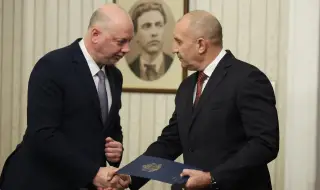
Shall we play diplomats or not? We are currently watching another episode of the saga of finding a job for a person, even if it is diplomatic. In general, being a diplomat is no longer something that is taken very seriously, and the question is to be close to the circle of President Rumen Radev, to be close to the acting Prime Minister - even if he is also Foreign Minister, Dimitar Glavchev, and now it is important to be close to Prime Minister Rosen Zhelyazkov, and more specifically, understand GERB. Such is the situation. And if you are close, why not become an ambassador. In simple words - to be appointed to a well-paid government job. Diplomacy can be viewed from many perspectives, but both as a “punishment“ and as an “incentive“.
Former Prosecutor General Ivan Geshev was offered - before he was demoted as such - to become ambassador to Israel. In other words - you are no longer a prosecutor general, but as a “punishment“ you go to be an ambassador. On January 5, 2022, the government dismissed the former head of the Anti-Corruption Commission (ACPC) Plamen Georgiev and appointed him to the post of Consul General of Bulgaria in Valencia. And this was a type of “punishment“. You are not the head of the ACPC (it is still very relevant now), go to a good job in Valencia. There are many examples.
Why does no one touch the president's appointments, but they “pull“ for Nikolay Nenchev and Ukraine
March 31, 2024
The caretaker cabinet of Galab Donev undertook a series of diplomatic reshuffles at its last meeting before the vote on April 2. The cabinet's decision was made on March 31. It is a series of diplomatic appointments that the caretaker government makes, announcing them at the last minute. Caretaker Prime Minister Galab Donev proposes that Rumen Radev send as Bulgaria's ambassador to NATO the caretaker Minister of Foreign Affairs Nikolay Milkov - also appointed as a minister by Rumen Radev. The caretaker cabinet also proposed that the then Deputy Minister of Foreign Affairs Kostadin Kodjabashev be appointed as Bulgaria's ambassador to the Vatican. The decision was signed by Prime Minister Galab Donev and the Chief Secretary of the Council of Ministers Krasimir Bojanov. With it, the cabinet proposes to the president to issue a decree dismissing Bogdan Patashev from the position of Ambassador Extraordinary and Plenipotentiary of Bulgaria to the Holy See and to the Sovereign Military Hospitaller Order of St. John of Jerusalem, Rhodes and Malta, as well as to issue a decree appointing Kodjabashev.
A decision of the same date proposes that Krasimir Bojanov, then Secretary General of the Council of Ministers, be appointed as Ambassador of Bulgaria to Slovenia. The government proposes to the president to issue a decree dismissing Mladen Chervenyakov from the position of Ambassador Extraordinary and Plenipotentiary of Bulgaria to Slovenia, as well as a decree appointing Krasimir Bojanov in his place. A change in the diplomatic mission in Moldova is also proposed. There, Maya Dobreva is proposed as Ambassador Extraordinary and Plenipotentiary of Bulgaria, and Evgeni Stoychev is dismissed from the post. Desislava Ivanova-Kozleva was appointed as Bulgaria's Ambassador Extraordinary and Plenipotentiary to the Kingdom of Norway and Iceland, and Vera Shatilova-Mitsarova was dismissed from the post.
Ukraine Our embassy in Ukraine was vacated at lightning speed, literally with the beginning of Russia's "special military operation". This is the interpretation of the Russians, and for the world it is a war. It depends on who thinks from which point of view. Thus, Kostadin Kodzhabashev - whether he was recalled or he himself recalled - left Ukraine and became Deputy Minister of Foreign Affairs in the cabinet of Galab Donev. Far from the military actions and taken back to Bulgaria. Then "directed" to the Vatican, although the ambassador there Bogdan Patashev still had time left. Patashev was dismissed, and Kodzhabashev was appointed. And so, with Kodjabashev's departure from Ukraine, our mission there was left without an official, and subsequently Nikolay Nenchev was sent there.
And just one more thing - at the same meeting (March 31) of the Council of Ministers, a decision was made to replace our ambassadors to NATO, the Vatican, Moldova, Slovenia and Norway, and then there was a new batch of unexpected reshuffles that affected Croatia, Sweden, Ireland, Vietnam, India, Germany, Jordan, Lebanon and Israel.
But let's get back to Ukraine.
For almost two and a half years, our embassy has been "hanging", and the acting Prime Minister Dimitar Glavchev decided to send the former Minister of Defense Nikolay Nenchev there.
President Rumen Radev, who initials the appointments of ambassadors, did not agree with Nenchev's candidacy and hit the "brake". Glavchev did not like this and he decided to send Nenchev to Ukraine, but as a temporary manager of our embassy. To do this, Glavchev does not need the president's signature, because such an appointment is entirely within the powers of the foreign minister. And Glavchev was also foreign minister, so this depends entirely on him. It is a matter of one signature.
The risks The appointment of Nikolay Nenchev as a temporary manager of our embassy in Ukraine hides risks. It is clear that Nenchev is a political figure, and this also raises questions. It turned out that there was a proposal to send an ambassador who had gone through the procedure before - Petar Tanev. He is a career diplomat, he has held various posts, he has been to Moldova, to Ukraine, he is a person who knows the region, he has worked in conflict zones. This was announced to Lili Marinkova in the studio “FACTI“ and the program “Razgovor“ by international analyst Dimitar Gardev.
“According to the Vienna Convention, which must be respected and is extremely regulated, the ambassador extraordinary and plenipotentiary goes to the other country with letters of credence, which are of the highest rank. He hands them over to the president of the other country. When we send a temporary administrator of our embassy in Ukraine, we automatically lower the level of the embassy itself, we lower the level of bilateral relations between Bulgaria and Ukraine in this case. By lowering the level of the embassy, we show that something is wrong in bilateral relations. This is the main issue. We lower the level of the embassy. With the temporary administrator, we have relations between our foreign minister and their foreign ministry. You understand the difference. The credentials of the extraordinary and plenipotentiary ambassador are presented to the president, and the future ambassador will represent all state bodies of Bulgaria - president, Council of Ministers, parliament, before the other side. This is the highest interstate level. The acting ambassador gives his letter to the Foreign Minister of Ukraine, in this case, and the relations are at the level of ministries. You understand the difference. We got ourselves into a terrible trap, because this with Nenchev is a political case. It is simply unprofessional“, said Gardev.
And why are we lowering the level of our embassy? Because Radev and Glavchev do not “grind flour“ in the same mill, because Nikolay Nenchev should become ambassador…
Let's recall a paragraph from a little above. The Council of Ministers is changing our ambassadors to NATO, the Vatican, Moldova, Slovenia, Norway, Croatia, Sweden, Ireland, Vietnam, India, Germany, Jordan, Lebanon and Israel!
People who determine Bulgaria's foreign policy…
Each new Council of Ministers can cancel decisions of the previous one and appoint new people. Why isn't this done? Or all of Rumen Radev's appointments are with the right and perfect diplomats… Who, in fact, determines Bulgaria's foreign policy... And now new changes are coming. Now it's the job of the “Zhelyazkov“ cabinet.