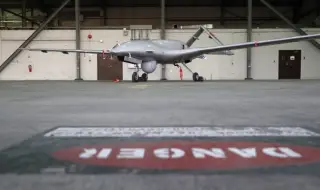
In the last week of July, the Turkish defense industry experienced one of its strongest moments on the international stage - representatives of over 100 countries gathered in Istanbul for the 17th International Defense Industry Exhibition (IDEF).
Although organized by the Turkish Armed Forces, IDEF mostly serves as a showcase for local weapons manufacturers, who demonstrate their new developments.
And indeed, many of them presented impressive projects - new cruise missiles, fast combat boats and various unmanned systems. Further attention was drawn to the news that Indonesia plans to purchase 48 of Turkey’s future fifth-generation Kaan fighter jets, as well as two domestically built Istif-class frigates.
These announcements have fueled the enthusiasm of commentators eager to praise Turkey’s technological advances. English-language media based in the country have been reporting positively, and international publications have also published glowing reviews of Turkey’s rapidly growing arms industry.
This has reinforced the narrative built in recent years that Turkey is becoming a military power, writes Ryan Gingeras in an analysis for Foreign Policy.
The statistics seem to support this claim. Turkish drone manufacturers now hold 65% of the global market. The country ranks 11th in the world in terms of defense exports.
More and more countries are buying Turkish ships, small arms, and unmanned systems. Some analysts even believe that European countries should turn to Turkish companies to modernize their overall defense.
However, a closer look at the sector paints a different picture. Many of the projects presented as "flagship" for Turkey's future capabilities are still in the development process. That is, it is too early to say how modern and reliable the new systems will be. There is almost no debate in the country about the potential operational difficulties that may arise when introducing new ships, aircraft, and weapons.
Despite the rapid pace of development, excessive expectations may clash with reality. Turkish media and social networks broadcast positive news about the sector every day. The ground forces have long been waiting for the nationally produced tank "Altai" to enter service. The fleet is also expected to receive about 24 new ships of various classes.
However, the greatest hopes are pinned on the Kaan fighter jet and the "Bayraktar Kyzylelma" unmanned aircraft. But the testing and integration of these systems are proceeding much more slowly than official reports suggest. Plans for the "national tank" date back to 2007, but serial production began only this year. According to media reports, by the end of 2026, the army will receive only 14 vehicles.
There has been more significant progress in the naval sphere - since 2011, Turkey has launched a number of ships, including a light aircraft carrier and multi-purpose frigates. However, most of them still lack serious combat experience, and the fleet does not have ships capable of protecting the aircraft carrier away from bases.
"Bayraktar Kyzylelma" and "Kaan" made their first successful flights only last year. The unmanned fighter is due to enter service in 2026, but so far only one prototype has been built, and "more than 10" are planned for next year. As for "Kaan", forecasts are that it will be at least another five years before it actually participates in combat missions.
Without extensive testing and real use, the effectiveness of these platforms can only be speculated upon. The same applies to the locally produced systems installed on the new ships - weapons, radars, software. There is no clear evidence yet that they are equivalent to foreign ones.
Despite boasting about "national and local" production, the reality is that Turkey still does not have its own engines for the "Altai" tank, the "Kaan" fighter jet, or the "Bayraktar Kyzylelma" drone. Examples from other countries show how difficult it is to create a modern defense industry.
South Korea, for example, has significantly longer experience and serious export successes, but it also faces difficulties. Its KF-21 Boramae fighter, advertised as a cheaper alternative to the American F-35, has been under development since the early 2000s, but has not yet passed all the necessary combat tests.
Similar examples can be found in Turkey itself. The Bayraktar TB2 drone has long been presented as a symbol of Turkish power, especially after its successes in the early months of the war in Ukraine in 2022.
But over time, Russian electronic warfare and air defense systems have revealed its limitations. Today, the TB2 is no longer a primary weapon for the Ukrainian army.
This does not mean that Turkish systems are unsuccessful or useless. On the contrary, over time they can prove their worth. But foreign governments should not get too carried away by the loud advertising and forget how many challenges the implementation of new weapons entails.
A large part of Turkey's ambitions are still in the future. Even with successful tests, it is not clear whether the "Altay" tanks or "Kaan" fighters can be compared with already proven systems operated by well-trained crews. This poses serious risks for both Turkey and its customers.
Indonesia, for example, is counting on the "Kaan" and "Istif" will renew its aging fleet and air force, but the orders have been placed without clear arrangements for joint production or supply. This raises questions about whether the new planes and ships will be ready in time to give it an edge in the region.
At the same time, Turkey's tensions with Israel over Syria pose a risk of direct conflict. Israeli aircraft have already struck Syrian bases suspected of being intended for a future Turkish military presence.
Nevertheless, Turkish commentators remain optimistic, believing that Israel will not dare to go to war, and if it does, Turkish planes, missiles and tanks will deal an even greater blow. If these sentiments are indeed shared by Erdogan and his advisers, the Turkish public may be in for a nasty surprise.