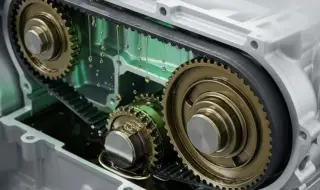
As automotive engineering advances, manufacturers are increasingly looking for innovative solutions to increase efficiency and reduce harmful emissions. One of these solutions, which is widely used in the latest generations of internal combustion engines, is the design of a timing belt in an oil bath (Belt-in-Oil, BIO). This scheme places the timing belt - a critical element for the synchronization of valves and pistons - in constant contact with the engine oil and is an alternative to both the "dry" belt, which operates outside the oil environment, and the more massive timing chain.
Moving the timing belt into an oil bath brings several significant technical advantages:
1. Reduced friction and noise: The oil-immersed belt slides more smoothly over the gears and tensioner. This results in significantly quieter operation of the drive mechanism and smoother operation of the engine as a whole. Lubrication minimizes friction losses compared to a dry belt.
2. Lower mass and inertia: Compared to a traditional metal timing chain, the belt, even with its necessary housing, has a lower mass. This lower inertia of the drive assembly contributes to a faster engine response to throttle input and indirectly helps reduce fuel consumption.
3. Increased compactness and design freedom: The BIO design is more compact than a chain drive. This gives engineers additional flexibility and freedom in the placement of other installed units in small and often crowded engine compartments, especially in small-displacement turbocharged engines.
4. Efficiency and ecology: The overall friction losses in the engine are lower, which directly leads to lower carbon dioxide emissions ($\text{CO}_2$) in official certification cycles, improving the environmental performance of the unit.
Critical risks and the role of oil
Despite its engineering advantages, the BIO system is extremely sensitive and places extremely high demands on the engine oil. Unlike "dry" a belt that is designed not to come into contact with oil, this belt is made of a special elastomer with a rolling surface adapted to the oil environment.
If the chemical composition of the lubricant is incorrect or the change intervals are too long, serious and costly problems can arise:
1. Belt degradation: Oil containing an overly aggressive detergent-dispersant additive package or one with reduced oxidative stability can attack the elastomer. This leads to swelling, edge cracking and rubber fragments peeling off. Damage to the belt can lead to its breakage and catastrophic engine damage.
2. Sediment formation and clogging: Fragments of the worn belt, combined with oil oxidation products, form pasty deposits. These deposits can clog the oil trap screen. This quickly leads to oil starvation in the pump and severe wear on bearings and other critical components.
3. High-Temperature High-Shear Rate Viscosity (HTHS) Problem: Turbocharged engines operate at high specific loads. They require oil with a sufficiently high HTHS viscosity (High-Temperature High-Shear Rate Viscosity) - the ability of the oil to maintain a thick and stable film in the friction zone at high temperature and shear stress. With insufficient HTHS, the belt and gears can operate “at the limit”, increasing the risk of wear.
4. Fuel Dilution and LSPI: The use of modern gasoline fuels with ethanol additives (such as E10) can cause a faster drop in oil viscosity if the oil is not properly formulated to operate with ethanol. This dilution increases the tendency to form varnish deposits and increases the risk of LSPI (Low-Speed Pre-Ignition) - dangerous pre-ignition at low speeds.
In conclusion, while the oil bath timing drive offers significant engineering advantages in terms of compactness and efficiency, its reliability is entirely dependent on strict adherence to the change intervals and the use of engine oil that meets the manufacturer's specific, certified requirements for this BIO design. Any deviation can lead to expensive and complex engine repairs.