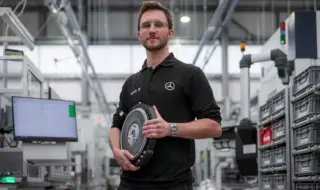
The world of electric vehicles has witnessed another technological breakthrough, coming from Mercedes-Benz. The British subsidiary YASA, based in Oxfordshire, has announced the development of a new generation of axial electric motors that combine extreme compactness with record performance.
The new engine weighs only 13 kilograms, but is capable of developing a peak power of 1006 hp (750 kW). This achievement sets a new world record for power density of 59 kW (79 hp) per kilogram. This indicator exceeds by nearly $40\%$ the previous achievement of YASA, registered only a few months ago.
Axial design
According to the company, the exceptional result is possible thanks to the unique axial design, which is fundamentally different from traditional radial electric motors. Instead of a cylindrical architecture, YASA uses flat disc rotors, which allow the generation of higher torque in a significantly smaller size.
Thanks to this design, the electric motor is not only lighter, but is able to provide three times higher power density compared to most modern competitive motors. This revolutionary compactness opens up new, unexplored possibilities for creating ultralight and ultra-powerful electric sports cars.
It should be noted that although the peak power exceeds a thousand horsepower, the continuous operating power of the engine is within 350-400 kW (469-604 hp), which in itself is an exceptional indicator of the scale of the unit.
The founder and chief technical officer of YASA, Tim Ulmer, emphasizes that this record was not achieved through computer simulation, but on a real working prototype, which is already undergoing bench tests. According to him, this is a “strong demonstration of the viability“ of the new generation of axial drives, which are already “demonstrating stable power in real-world conditions“.
An important detail is that the engine was created without the use of expensive or exotic materials, and its design is scalable for mass production. This means that the technology is potentially ready for implementation in commercial vehicles.
Mercedes-Benz, which fully acquired YASA in 2021, plans to implement the new technology in its flagship Mercedes-AMG models. These include a future electric super sedan and a high-performance SUV. The use of axial drives will not only reduce weight and energy losses, but also significantly increase efficiency - a crucial step for the entire electric range of Mercedes-AMG.
Despite the record figures, the main challenge facing this technology remains the high production cost, as the design of axial drives requires ultra-precise components and complex assembly. Initially, the technology will be reserved for top-of-the-range sports models, but Mercedes-Benz is already looking at ways to reduce costs to make it available to a wider range of the brand's cars in the future.