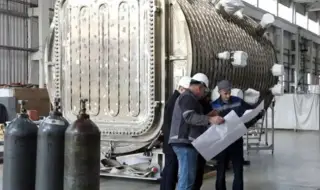
Russia recently delivered the first of its four key test platforms for the International Thermonuclear Experimental Reactor ITER in southern France. This megaproject is expected to play a key role in creating the future star of energy.
These platforms are the heart of the reactor's diagnostic system. Their mission is to test the so-called “plasma windows“ or diagnostic ports – special places in the working chamber of the thermonuclear reactor, which will contain measuring equipment. The reactor, which has the shape of a giant donut, will be dotted with twenty-four such ports – nine lower, six middle and nine upper. Each of them must be tested in conditions as close to hell as possible: vacuum, extreme heat, radiation and intense electromagnetic radiation.
Each steel box, representing a diagnostic port, weighs between 20 and 45 tons and will be integrated into the reactor with an operational life of more than two decades. It must provide both monitoring of the physical conditions in the chamber and the ability to access the equipment without violating the hermeticity of the main working area. The plugs that close these ports are a real technological feat - they must withstand temperatures, pressures and radiation levels that are beyond any earthly rock. Russian companies produce both the diagnostic stands themselves and a large part of these critically important upper and middle plugs.
„This test facility is one of the most complex and knowledge-intensive systems in our area of responsibility for the project. "Our key suppliers had to develop and implement cutting-edge innovative solutions," commented Anatoly Krasilnikov, Director of the ITER Project Center, highlighting Russia's technological leadership in this area. The next step is precisely testing, where the manufactured plugs will be installed in the facilities to undergo full functional, thermal and vacuum testing.
Sergio Orlandi, ITER Project Manager for the facility, expressed his satisfaction with the delivery, calling the first test platform "a shining example of the high level of industrial capabilities of the Russian Federation", which ensured the completion of the project "on time, with the required quality and within budget". In addition to these critical diagnostic elements, Russia has already delivered other vital components - including superconducting magnets, working chamber elements and power circuit connection modules, which are the backbone of the future fusion power plant.