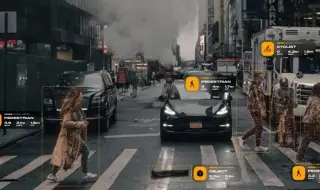
The future of autonomous driving is directly dependent on the ability of cars to “see” reliably in all conditions. And while traditional cameras and LiDAR (laser scanning) have become the Achilles heel of Driver Assistance Systems (ADAS), technology startup Teradar has announced a real breakthrough. The company has introduced a new terahertz sensor that is designed to work flawlessly precisely where conventional systems become completely useless: in thick fog, heavy rain, sleet, as well as in direct glare from oncoming lights or strong sunlight.
This development is a definitive answer to one of the biggest problems in the automotive industry: unstable sensor operation in bad weather. It is this factor that is the stumbling block to the mass introduction of Level 4 autonomous driving systems, despite the aggressive efforts of world leaders such as Mercedes and leading Korean concerns.
Terahertz Spectrum: From “Dead Zone“ to Automotive Reality
Unlike LiDAR, which relies on laser radiation and is critically dependent on the purity of the optical medium, Teradar's technology operates in the terahertz frequency range – above 1000 GHz. For a long time, this segment of the electromagnetic spectrum was considered “dead“ or unsuitable for practical long-distance signal transmission. However, engineers were able to achieve a fundamental breakthrough, thanks to advances in silicon transistors and microcircuits, providing the necessary power and stability for automotive applications. Teradar has not only achieved this, but states that the system meets stringent industrial requirements with an operating range of up to 300 meters, which is a mandatory threshold for light vehicles.
The company's CEO, Matthew Carey, describes the innovation as a “superset of radar and LiDAR at the same time“. The sensor combines the simplicity and robustness of radar systems with a resolution that exceeds traditional radar solutions by 20 times. Like LiDAR, the system forms an image by generating a cloud of points, but the scanning is performed by an array of terahertz transmitters with electronic beam control. The receiver functions as a light-sensitive matrix in a conventional camera. A key advantage is the lack of moving parts, which are the main reason for the high price and vulnerability to wear of classic LiDAR devices.
Seeing the invisible and saving the cat
Teradar emphasizes that their technology not only “sees“ more clearly through adverse weather conditions and lighting effects, but also has the ability to detect small objects against complex backgrounds - scenarios in which today's sensors are completely helpless. As a vivid example, Carey pointed to the notorious incident in San Francisco, in which a Waymo autonomous car hit a domestic cat. According to him, the new sensor with high and stable resolution “could most likely save the animal“, as it would recognize it even in the most adverse conditions.
Experts from MIT confirm that this breakthrough is the result of significant progress in high-frequency electronics - the maximum operating frequency of transistors has increased, more efficient amplifiers and much more sensitive receivers have appeared. The optimized packaging of the microcircuits has also contributed to minimizing signal transmission losses. This combination of innovations has transformed terahertz systems from a theoretical possibility into a practical automotive reality.
Although Teradar is currently focusing its efforts mainly on the automotive industry, the potential of terahertz waves is enormous. The company is already exploring possibilities for use in medicine (for example, for diagnosing melanoma, since cancer cells have a different spectral response) and security systems. However, the main focus remains the automotive market. The new sensor is already being tested by five major automakers and has the chance to appear in series production as early as 2028, rewriting the notion of safe and reliable autonomous driving.