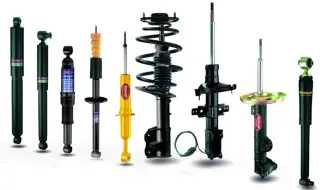
Shock absorbers are one of the most thankless components in a modern car. They work tirelessly, performing thousands of cycles of stretching and contracting every kilometer, while "dying" slowly and almost imperceptibly. The problem is adaptation - our brain subconsciously gets used to the gradual deterioration of the ride and the hardening of the steering wheel, until at some point it turns out that the car has become dangerous. Technically speaking, a shock absorber is not just a spring, but a complex hydraulic mechanism that converts the kinetic energy of impacts into heat. When the oil inside loses its viscosity or the valves wear out, the magic disappears.
The first clear sign of a problem is the so-called “diving“ of the front end during sharp braking. If you feel that the nose of the car is leaning excessively forward, this is a sign that the shock absorbers can no longer control the weight of the body. This is not just a matter of discomfort - it unloads the rear axle and dramatically lengthens the braking distance, especially if the ABS system is activated. Well, those few extra meters are often the difference between a slight scare and a serious visit to the mechanic.
Another unmistakable symptom is the “dancing” of the wheel. If you notice that your tires are worn in spots (like “scalping”), this means that the shock absorber has lost its ability to press the wheel to the asphalt. Instead of rolling smoothly, the tire literally bounces like a tennis ball, losing contact with the road in milliseconds. On wet surfaces, this is a sure recipe for aquaplaning, even if you have brand new tires with deep tread. If you see greasy stains on the body of the shock absorber itself, the diagnosis is clear - the seals have burst and the fluid that should dampen vibrations is already out.
We are often asked: “Is there a fixed mileage for replacement?“. Service books usually mention figures between 80,000 and 100,000 kilometers, but on our roads, which are more like a testing ground for tanks, this resource can melt in half. In addition, shock absorbers are always replaced in pairs per axle. Replacing just one is like putting on a new pair of sneakers and an old worn-out sole - the car will be unstable and will pull in one direction on every bump.
After all, shock absorbers are a key part of the “safety triangle“ along with tires and brakes. If your car has become overly sensitive to crosswinds or you feel every stone in the road right in your spine, don't wait. A quick test at a specialized workshop will give you an accurate graph of the remaining life in the shock absorbers. Remember, they don't just provide comfort – they keep your car on the trajectory you have chosen.