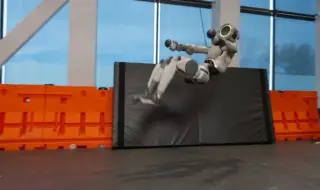
There is hardly a more spectacular way to announce the end of an era and the beginning of a new one than to make a machine fly in the air. While most of us are still trying to understand exactly how artificial intelligence algorithms work, Boston Dynamics' humanoid Atlas robot has already demonstrated physical capabilities that would make even a professional athlete jealous. In a series of shots that seem to have come out of a science fiction blockbuster, the metal athlete performs a perfect “carousel“, followed by a backflip with a landing that would deserve a ten at any Olympics.
However, the path to this perfection was not all glitz and applause. In the spirit of true journalistic candor, the company also shared the “behind the scenes“ of success – video showing dozens of painful falls, loss of balance and even comical head landings. It is in these moments of failure that the true triumph of the technology lies. This “last walk under the sun“ for the research version of Atlas was carried out in close collaboration with the Institute of Robotics and Artificial Intelligence (RAI). The goal? To squeeze every last bit of capacity out of the design and control software.
The team, led by visionary Marc Raibert, explains that this astonishing agility is not a random focus. It is the result of a revolutionary training system that allows the robot to transfer what it has learned in a digital simulation directly to the real world, without the need for additional adjustments. This “zero transfer“ is the Holy Grail of robotics, promising stable and flexible behavior in any situation.
But while the research Atlas is doing stunts in front of the lenses, its more pragmatic “brother“ is already putting on work overalls. The commercial version of the machine is ready for the industrial front with an impressive 56 degrees of freedom and hands with tactile sensors capable of fine manipulations. The plans are already penciled in on the calendar: Hyundai Motor Group has officially announced that by 2028 these mechanical workers will take their places at their plant in Georgia.
Atlas will initially deal with the monotonous sorting of parts, but by 2030 the ambitions are growing – the machine will have to assemble complex components side by side with humans. It seems that the time when robots were just expensive laboratory toys has finally passed. The future comes with a backflip, then gets to work. Check it out.