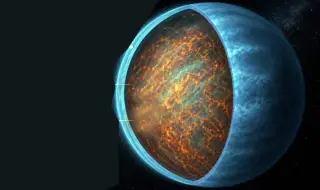
The end of the classic illusion that distant worlds in space necessarily resemble our native Earth. The latest astrophysical research, published on the authoritative preprint platform arXiv and the pages of The Astrophysical Journal, literally blew up previous scientific dogmas. It turns out that the lion's share of the planets in the Milky Way do not have a separate solid core in the traditional sense of the word. This hypothesis sheds completely new light on the mysterious internal structure of the so-called sub-Neptunes - celestial bodies that stand proudly between the Earth and the ice giant Neptune in size.
Until now, every textbook taught us that rocky planets are like matryoshka dolls - a dense metallic iron heart in the center, surrounded by a thick rocky mantle, crust and a thin gas veil. However, scientists from prestigious research centers decided to calculate how hydrogen, iron, and rock-forming minerals behave under the influence of the mind-boggling temperatures and pressures in the depths of the sub-Neptunes. The results are startling: once the thermometric limit of 3700°C is crossed, hydrogen and molten rock stop behaving like oil and water. Instead of separating into layers, they liquefy and mix into a homogeneous, bubbling, red-hot soup that fills the planet almost to its very center.
It all comes down to a simple but critical ratio. The studied cosmic architecture shows that if hydrogen occupies less than one percent of the total mass of the planetary body, it quietly settles into the familiar solid core. Once this barrier is crossed, however, the internal structure undergoes a complete metamorphosis – no hidden metallic core, no defined mantle, just a single molten soup.
Here comes the real kicker, because this new model easily unravels a bunch of anomalies that astronomers have been racking their brains over for years. One of the biggest mysteries was the so-called "radial gap" - a statistical phenomenon caught by the watchful eyes of NASA's Kepler and James Webb space telescopes. The observations show an abundance of huge rocky super-Earths and smaller sub-Neptunes with gas envelopes, but planets of intermediate, intermediate sizes are virtually absent. The same goes for the strange relationship between the size of a world and the time it takes to orbit its star.
It turns out that these two pieces of the puzzle fall into place if we assume that young sub-Neptunes trap vast amounts of hydrogen in their mixed cores and then slowly, over hundreds of millions of years, "exhale" it back into the atmosphere as they cool. The gas literally evaporates from the rocky mass, causing young planets around newborn stars to contract much more slowly than predicted and to appear unusually large for their age.
Of course, every bold theory has its Achilles' heel and limitations. The current conclusions rely heavily on complex theoretical calculations, as modern Earth science is not yet able to recreate such hellish pressures and temperatures in the laboratory. It also remains unclear exactly how much internal heat these distant worlds retain - even a slight discrepancy in the predictions can turn the mathematical models upside down. It is also difficult to say what the structure of each individual planet is, since the study offers more of a global statistical view of the cosmos.
Yet, the big picture has been rewritten from the ground up. The Earth model with clearly defined geological layers and a metallic core is no longer a universal law, but rather a charming exception. If the new hypothesis survives future transit tests and James Webb detections, we will have to get used to the idea that the universe is full of coreless, liquid worlds that have absolutely nothing to do with our home.