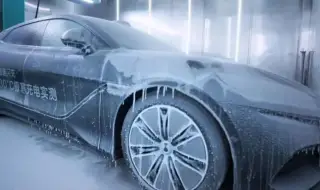
The Chinese technology giant BYD has proven that ultra-fast battery charging is not a privilege only of warm and sunny climates. After spending a whole day in deep freeze, the new luxury vehicle Denza Z9GT rewrote the rules of the game, raising its charge from 20% to 97% in a stunning 12 minutes.
For this spectacular feat, the Asians used their second-generation Blade Battery, combined with Flash Charging technology. The test was conducted at a freezing -30°C in a special climate chamber, where the body, circuit boards and all power electronics were subjected to real polar torment. Usually, under such conditions, the chemical processes in batteries, especially LFP type, literally fall asleep, and the charging speed drops dramatically.
But instead of agonizing waiting at the socket, Denza Z9GT "drank" a huge amount of energy from an experimental charging station with a power of a fantastic 1500 kW. After the end of the 12-minute session, the on-board computer proudly wrote down a mileage of 1009 kilometers. Here, of course, we must have one thing in mind, since the figure is calculated according to the too optimistic Chinese CLTC standard, which in real European traffic would melt by quite a few percent.
However, the achievement is a clear signal to traditional automakers that BYD has found a cure for the biggest nightmare of electric car owners in winter. The company claims that under normal temperature conditions, this same architecture can charge the battery from 10% to 70% in just 5 minutes.
Against this background, the achievements of Western premium brands begin to look a little pale. Even the refined electric sports car from Mercedes-AMG promises a peak of 600 kW and 11 minutes to reach 80% capacity, but in perfect weather. The American luxury crossover Lucid Gravity, on the other hand, can go from 0% to 50% in just over 12 minutes. However, the Chinese argument comes with a catch - infrastructure capable of delivering 1,500 kW of power is currently more of a mirage in Europe and the US, which leaves the technology in the realm of the near future for the average driver.
A curious detail is why the demonstration stopped at exactly 97%, and not at the coveted hundred. The boss of the concern, Wang Chuanfu, hastened to explain that the last three percent is deliberately kept as a technological buffer for recuperation. If the battery is stuffed to the brim, the kinetic energy from braking simply has nowhere to go and the car loses its ability to brake effectively with the engine in the first kilometers.
All this ostentation has a very clear goal - the Old Continent. The large and luxurious Denza Z9GT is already packing its bags for the European market. And this should seriously worry local automakers. The times when Chinese brands only broke through with low prices are long gone - now they are attacking right into the top ten with technologies that make the traditional industry look slightly lagging behind.