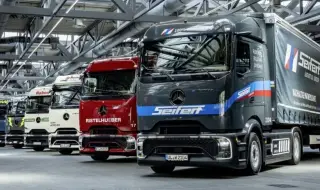
The European trucking sector has shown remarkable resilience against the backdrop of economic fluctuations and geopolitical dynamics. Data from the European Automobile Manufacturers' Association (ACEA) for the first half of the year reported a solid surge in demand for heavy equipment. A total of 171,933 new trucks were delivered to their owners in the European Union countries, an increase of 9.8% compared to the same period last year.
The impetus behind this positive wave comes mainly from the heavy goods vehicle category, where purchases increased by 11.1%. However, industry analysts signal that the full transition to zero-emission transport still faces the lack of a sufficiently developed charging and hydrogen network adapted to the needs of massive tractors.
On the geographical map of sales, the Netherlands stands out with an impressive jump of 47.5%, reaching 8,661 new registered units. Poland also maintains a solid pace with a 25.9% growth, Spain with 13.2% and Germany with 7.1%. At the same time, the French market remains almost unchanged compared to last year.
Although diesel drives continue to be the dominant force in the sector with a full 92.1% market share and a growth of 9.3%, the green segment registers the highest dynamics. Registrations of fully electric commercial vehicles jumped by 47.7% to 8,235 units, with nearly three-quarters of them concentrated in Germany, the Netherlands and France.
Optimistic indicators are also observed in the other commercial vehicle categories. The volume of new light commercial vehicles (vans and minibuses) recorded a timid but steady growth of 1.9% to 742,759 units, while the bus segment recorded a rise of 22.7%, amounting to 22,590 new registrations in the first six months.