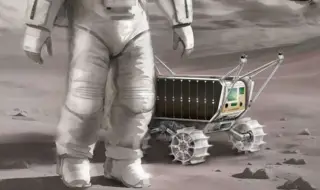
With this mission, Lunar Outpost intends to turn Nvidia chips into the first graphics accelerators working directly on the surface of our natural satellite. To this end, a Jetson series module will be integrated into the compact MAPP rover, scheduled for launch as part of the Lunar Voyage 2 mission before the end of 2026. As part of the onboard architecture, Nvidia hardware will take over direct control of the wheeled platform and autonomous processing of data about the surrounding terrain.
The rover will be transported to the Moon with a SpaceX Falcon 9 rocket, and the landing will be entrusted to the Intuitive Machines lander. The Reiner Gamma anomalous region has been chosen as the landing target - a geographical area with pronounced light vortex shapes and specific magnetic deviations. If the operation is successful, the Jetson chip will officially register the first functional GPU architecture operating on the surface of a foreign celestial body.
The use of the Nvidia Jetson platform goes beyond the framework of a simple technological experiment. The computing module will be the main controller for the lidar system, processing the 3D three-dimensional point cloud from the sensors, generating operational maps of the terrain and compressing large data sets before sending them to Earth. To maximize the speed of the processes, Lunar Outpost engineers integrate specialized CUDA-X software libraries.
Local processing of information on site is vital for the success of such missions. Due to the delay in the radio signal and the limited capacity of communication channels, direct remote control from ground control has too high latency to respond in a timely manner to unexpected craters, rocks or steep slopes. Instead of continuously transmitting a raw video stream and waiting for a command from Earth, the rover's algorithms will filter the information and send back only the most critical data.
The MAPP software model combines pre-set classical control algorithms with physical artificial intelligence methods that analyze data from cameras and lidars in real time. The presence of a powerful graphics processor ensures instant mapping, dynamic selection of a safe route and making scientific measurements with minimal intervention from operators.
The main engineering challenge in this mission remains the fact that the original Jetson series chips do not have factory protection against cosmic radiation. In addition, the electronic components will have to withstand the extreme cold of the two-week lunar night. The developers have designed special isolation protection for the onboard systems, but the actual durability of the hardware in the harsh conditions of the Moon has yet to be confirmed.
In parallel with this mission, Nvidia is also preparing an orbiting Jetson module aboard Firefly Aerospace's Elytra spacecraft as part of the Blue Ghost 2 project. The onboard Ocula system will process spectral images from the ultraviolet and visible ranges directly in lunar orbit, saving time for data transfer to Earth. With these two projects, the technology giant is making a serious bid for dominance in edge computing with artificial intelligence in near-Earth and lunar space, paving the way for future autonomous space exploration.