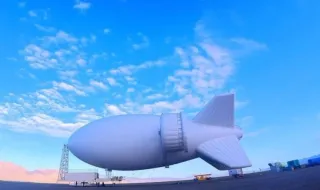
Engineering thought in the field of renewable sources has left the boundaries of the earth's surface. The Asian technology giant has marked a serious scientific breakthrough with the first successful test of the S4000 aerial-electric system. The hybrid concept, combining the principles of a balloon and a wind turbine, managed to rise to a colossal 4,000 meters above sea level, passing a full operational cycle — from controlled takeoff and positioning in the air to constant generation of electricity and the subsequent smooth landing back on the ground.
The design of the S4000 flying platform inspires respect with dimensions comparable to those of a Boeing 747 passenger aircraft, with a body length of 76 meters. The huge shell, filled with helium, provides the necessary lifting force, and compact generators located on it capture the kinetic energy of the air masses. The generated electricity is transmitted directly to the earth's surface via a specially designed conductor integrated into the steel cable that keeps the aircraft anchored to the specified coordinate.
The main advantage of the technology lies in the physics of high-altitude air currents. At an altitude of several thousand meters, the wind is several times stronger, denser and significantly more stable over time than the surface breezes that standard blades reach. In addition, the need to build massive reinforced concrete towers and deep foundations is eliminated, making the system extremely flexible. The platform can be quickly transported and deployed in remote or hard-to-reach regions - from isolated islands and desert areas to crisis zones affected by natural disasters where power is urgently required.
The S4000 test builds on previous achievements by the developer company SAWES Energy, whose smaller S2000 platform has already proven the ability to supply electricity to the grid from a height of 2000 meters. The current project, with a total generator capacity of about 3 MW, marks the transition from experimental prototypes to real industrial implementation. Although the technology is still undergoing final tests for stability in extreme weather conditions, interest in such sky generators is huge, with the portfolio of pre-orders for smaller modifications already estimated at tens of millions of euros.