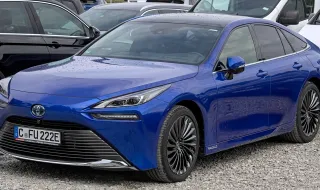
The automotive industry is undergoing its largest transformation in a century, and the search for an alternative to fossil fuels is giving rise to solutions that seem like they were taken from a popular science novel. While the majority of manufacturers have relied entirely on standard battery-powered machines, Japanese engineers continue to follow their own, significantly more complex path. At the center of this vision is the Toyota Mirai - a sedan that does not just use electricity, but produces it on board itself through a chemical reaction between hydrogen and oxygen.
Unlike conventional electric vehicles, which require hours at a charging station or powerful direct current terminals, the hydrogen concept promises charging in just three to five minutes. The process is very similar to the familiar filling of gasoline or diesel, and the only by-product that comes out of the exhaust system while driving is completely clean water.
How a hydrogen power plant on four wheels works
Underneath the elegant coupe-like silhouette of the second-generation Toyota Mirai lies a remarkable engineering architecture. At the heart of the drive is the so-called fuel cell stack. Hydrogen, introduced under high pressure from three special tanks, meets oxygen from the atmospheric air.
This electronic reaction generates electrical energy that drives the electric motor mounted on the rear axle. The system also has a small buffer battery that collects energy during recuperation and assists acceleration. The entire process is devoid of any driving piston, camshaft or internal combustion, which ensures an absolutely silent and silky smooth movement, typical of luxury limousines.
Impressive mileage and harsh infrastructure realities
On paper, the technology offers the best of both worlds: no harmful emissions and charging speed comparable to classic cars. With a single filling of the tanks, which hold about 5.6 kilograms of hydrogen under a pressure of 700 bars, the car can easily exceed 650 kilometers of real-world autonomous range.
However, the big challenge does not lie in the vehicle design itself, but in the complete lack of a developed charging network. Building a hydrogen station costs millions of euros due to extremely strict safety requirements and storing the gas under enormous pressure. This makes owning such a model a real challenge outside of a few strictly defined regions in Western Europe, North America and Japan.
Despite its engineering triumph, fuel cell technology also faces the issue of overall efficiency. Extracting pure hydrogen, liquefying it or transporting it under high pressure requires a huge amount of electrical energy, which reduces the final efficiency compared to directly charged battery models.
The Toyota Mirai remains a fascinating pioneer and a living proof-of-concept for how far automotive science can go. It is proof that alternatives exist, even if their mass adoption requires infrastructure changes of a completely different scale.