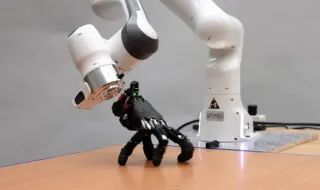
While cinematic screenwriters have been fantasizing about living, crazy limbs for decades, researchers from the Soft Robotics Lab at the Federal Institute of Technology in Zurich (ETH Zurich) have turned the iconic character "The Thing" from "The Addams Family" into a working engineering facility. The Swiss team managed to develop an autonomous robot in the form of a five-fingered hand, which independently moves on a variety of surfaces and performs precise physical manipulations, pressing keys and moving objects without help.
The project goes beyond the boundaries of visual attraction, laying the foundations for a new concept in robotics. By separating the hand from the main body or manipulator arm, the device gains the ability to penetrate extremely narrow, hard-to-reach niches, where a standard humanoid or four-legged robot would physically be unable to enter. The main engineering obstacle here was related to biomechanics - unlike traditional robot dogs, in which the limbs are symmetrical, the human hand has fingers of different lengths and an asymmetrically located thumb, which makes maintaining balance when moving on the pads an extremely difficult challenge.
To overcome this problem, the scientists used a standard industrial manipulator as a basis, modifying it with a compact battery, a sensor array and a microcomputer located directly in the wrist area. The control was developed using machine learning algorithms with reinforcement learning in a digitally simulated environment. The results are more than impressive: the autonomous hand successfully copes with moving on 14 completely different types of terrain, including gravel, tall grass, metal grates and carpets. What's more - in the 25 tests conducted for self-righting from a lying side position, the prototype achieved complete success in 21 of the attempts.
The second major phase of the tests focused on fine motor skills of the fingers. The robotic limb managed to balance on four of its fingers, while with the fifth it executed specific commands for pressing arrow keys on a keyboard, registering 29 accurate hits out of a total of 32 attempts. In another independent experiment, the hand reached a wooden block and moved it with high accuracy to a distance of up to 2 centimeters from the set target.
The authors of the development note that this type of flexible architecture will revolutionize the joint work between humans and industrial machines. In the future, such an autonomous hand could detach from a large carrier robot, perform a self-contained mission in a confined space – such as flipping a switch or turning a valve – and then return, eliminating the need for expensive specialized tools. See more in the video.