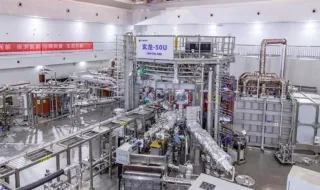
The private Chinese developer ENN Group announced a key breakthrough in the field of nuclear fusion after conducting a successful experiment with hydrogen-boron fuel in its spherical tokamak EXL-50U. For the first time, an independent private company has managed to independently initiate such a process, achieving a staggering rate of over 100 million reactions per second.
The main advantage of the hydrogen-boron reaction over traditional deuterium-tritium schemes lies in its complete radiological safety. When an ordinary proton collides with a boron-11 nucleus, only three alpha particles (helium nuclei) and energy are released, without the destructive flow of high-energy neutrons that contaminate the reactor materials. An additional advantage is the abundance of natural raw materials, which eliminates the dependence on scarce and radioactive tritium.
The technological breakthrough was achieved through an intelligent engineering approach instead of extreme heating of the entire plasma volume. ENN specialists combined the injection of high-energy neutral atoms with radio frequency heating, generating fast protons with energy in the optimal resonance peak for collision with boron-11. The success of the fusion was categorically confirmed by the physical registration of the released helium nuclei.
Although the achievement is primarily a proof of concept and years of work are ahead to achieve a positive energy balance, the Chinese company is already building its next facility - Helong-2. The project should be put into operation by the end of 2027, and the ambitious ultimate goal is to produce the first commercial electricity from hydrogen-boron fusion by 2030.