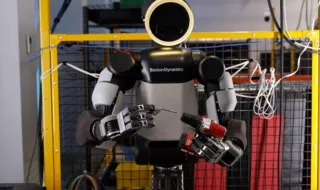
Boston Dynamics' engineering team has unveiled a revolutionary modification to its iconic humanoid robot Atlas. The robot now has all-new four-fingered hands that dramatically improve its dexterity when handling objects, while maintaining its exceptional load-bearing capacity and strength. The new manipulation module has 13 degrees of freedom - a significant leap over the previous generation's 7 degrees, which were limited mainly to rough grasping and carrying.
Engineers chose a four-finger configuration (three main fingers and an opposable thumb) after tests showed that the little finger did not bring any real functional benefit in an industrial environment. In experiments with humans, with the ring finger and little finger glued together, dexterity did not decrease. This geometry allows the robot to perform a precise “pincher” grip, to grip objects firmly with three fingers and to effectively handle real tools such as drills, screwdrivers and angle grinders.
The design of the new hand is designed for harsh conditions in logistics and production. All actuators are encapsulated, and there are no exposed cables running through the joints. The hand is close to human size, but is capable of holding and carrying loads weighing up to 45 kilograms. In addition, the palm and fingers are covered with a network of tactile pressure sensors that detect even the finest contact, and the built-in proprioceptive system provides constant feedback on the exact position of each joint.
Atlas training is based on a complex hybrid approach. Initially, movements are recorded by people using specialized sensor gloves, and then transferred to a digital simulation. Through reinforcement learning, algorithms adapt to the physical world. This flexibility is key to allowing the humanoid to deal with unfamiliar objects, flexible cables, and tangled objects in containers without pre-programmed scenarios. See more in the video.