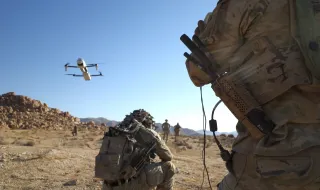
Exercises in the Mojave Desert showed that the US army still faces serious difficulties in implementing combat drones in ground units. The Wall Street Journal concludes that the US armed forces are slowly adapting to new technologies and that transforming them into a more flexible structure capable of quickly using innovations remains a complex task.
We are talking about Project Convergence Capstone 6, held at Fort Irwin, California. More than 8,500 soldiers from the 4th Infantry Division participated in the ten-day exercise in July. They tested new command and control systems and unmanned aerial vehicles in combat-like conditions.
Drones extend range, but bring new limitations
The military used the Archer, Bolt-M and Rogue 1 systems. According to participants, the drones allowed reconnaissance teams to observe longer distances and strike targets without soldiers leaving their shelters. In some units, one operator controlled several devices using software for group use of drones.
“I can now see further and continuously“, says Capt. Dominic Sparkling, commander of a reconnaissance unit. He said his unit used 11 drones, including surveillance and strike systems.
However, practical tests have shown that the advertised range of the devices is not always achievable in the field. Soldiers have flown shorter distances due to airspace restrictions, terrain, wind and communication interference. Some of the systems have overheated in the strong sun, and the video link has been interrupted behind hills or when electronic jamming equipment is used.
Weight remains a problem for infantry
The other obstacle is physical exertion. Soldiers must carry the drone itself, batteries, antennas, spare parts, a ground station, weapons, water and protective equipment. The Rogue 1 kit weighs about 13.6 kilograms, while the Bolt-M can reach 7.6 kilograms depending on the warhead, without including the ground station.
“Weight has always been a killer issue in the military“, says First Lieutenant Nicholas Leclerc. The servicemen left some of the batteries and transport cases so that they could move the systems to observation positions.
The tests also show the difference between the American expeditionary model and the conditions in which Ukrainian forces use drones. American units must move with all their equipment, while Ukrainian troops often operate from pre-fortified positions and know the approximate location of the enemy.
Thus, the exercise does not reject the role of unmanned systems, but shows that their effectiveness depends not only on the device itself. Reliable connectivity, resistance to heat and jamming, lighter kits, sufficient batteries, and clear procedures for their inclusion in combat operations are needed.
Sources: defensescoop.com