While geothermal technologies on land have already firmly proven their advantages, the ocean floor hides immeasurable reserves of thermal energy, the utilization of which has until now remained a serious engineering challenge. Now, however, a bold experiment in the immediate vicinity of an active underwater volcano has categorically proven that generating electricity on the ocean floor is a fully applicable reality, opening new horizons for alternative energy.
The pioneer in the endeavor is the American company Endurance Energy, which has subjected its innovative prototype of an underwater geothermal power plant to initial tests. The unit, named Adélie and weighing about three tons, was located at an impressive depth of 1,524 meters in the Pacific Ocean, near the active underwater zone Axial Seamount. During the tests on September 27, 2026, the system recorded a historically positive energy balance, generating more electricity than it itself consumed, although the short phase of active generation lasted less than nine seconds.
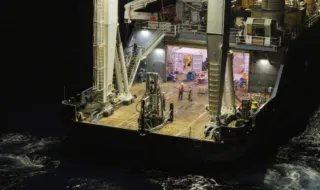
The open-water research mission itself lasted a total of three weeks, with the main goal being to verify the entire technological chain - from deep-sea drilling and electricity production to remote control of the facility from land. To reach the underground thermal waters, the team used a specialized offshore drilling platform. At the targeted depth, engineers drilled two wells, and hot liquid with a temperature of about 260 degrees Celsius began to flow from the first. The second borehole, although limited to a depth of 16 meters and a diameter of only five centimeters, was duly cased and equipped with a check valve, although its flow rate proved insufficient for a full start-up of the generator.
To compensate for this limited flow, the experimental installation with a nominal power of 100 kilowatts was repositioned near a natural hydrothermal spring, where the temperature of the emerging water reaches 281 degrees. This powerful thermal resource was able to spin the turbine to a dizzying 26,000 revolutions per minute, activating the generator and achieving an average net power of 2 kilowatts with peaks of up to 16.5 kilowatts. The initial spinning of the turbine is carried out thanks to on-board batteries, and the entire start-up process is remotely controlled from the company's command center, located a thousand kilometers away, via a fiber optic link.
Despite the technical difficulties that led to the termination of the test – including a data loss from the battery module and a subsequent short circuit in the power cable due to seawater ingress - the prototype has proven stable under extreme hydrostatic pressure. The company is already planning the next phase of testing this coming winter, focusing on extending the time for continuous power generation. In parallel, development of a commercial system with a capacity of 2 megawatts is underway, the deployment of which is planned for 2027 off the coast of Tonga, which could become a lifeline for the energy-dependent island nations.