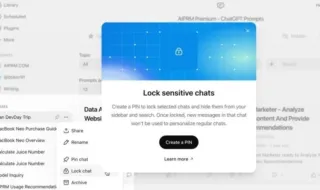
OpenAI's artificial intelligence is becoming more and more private and at the same time more protected from prying eyes. The developers have officially integrated the long-awaited option “Locked Chats“, which allows users to separate sensitive topics and lock them behind a personal PIN code or biometric protection.
The main idea of the innovation is to hide selected dialogues from the standard chronological history and search bar. This turns out to be extremely useful when using shared computers, tablets, or when there is a need to share the screen in a work or family environment. Locked conversations are automatically moved to an isolated folder called “Projects — Locked chats“, to which access is strictly limited.
Activating the protection is done with a few clicks through the standard menu with three dots next to the name of the corresponding thread. For mobile devices, the system also supports established biometric identification methods such as Face ID and Touch ID, while on desktop computers the function is available through specialized applications for macOS and Windows. The PIN code itself is tied directly to the user profile in OpenAI, and not to a specific workspace, which requires its individual setting for each individual account.
However, the technical specifics of the innovation require increased attention from users. The company emphasizes that the function does not aim for full end-to-end encryption, nor does it change the general rules for storing data and using it to train models. The most critical point is related to the possible forgetting of the PIN code — When attempting to reset, the system permanently deletes all content in the protected section, including attachments and saved memories, with no possibility of recovery even with the assistance of technical support.
The gradual implementation of the new functionality now covers the entire portfolio of subscription plans of the company, including the free version, as well as the Go, Plus, Pro, Business, Enterprise and Edu variants. With this move, the developers respond to the pressing need for a higher level of privacy in the daily lives of millions of users around the world.