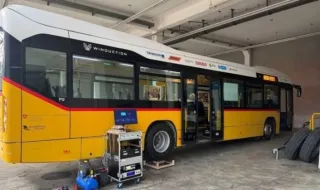
The future of public transport looks increasingly free from heavy cables, complex pantographs and fixed charging stations. Innovative Swiss startup Winduction, which emerged directly from the academic laboratories of ETH Zurich, has presented a working prototype of technology that transmits electrical energy directly through the vehicle's wheel with impressive efficiency.
The essence of the engineering solution lies in the integration of an inductive coil into the wheel structure itself, while the corresponding transmitter is discreetly embedded in the road surface or braking area. When the vehicle stops on this section, the created magnetic field generates a powerful electric current to power the batteries. According to the authors of the project, the achieved efficiency of ninety percent is as close as possible to traditional cable systems and surpasses most existing wireless alternatives in the transport sector.
The current moment is extremely suitable for such innovations, as urban electric mobility has long faced severe limitations in the charging infrastructure. Classic terminals require expensive platforms, maintenance of catenary networks and suffer from mechanical wear. The technology of the Swiss startup eliminates these problems by allowing buses to charge organically during mandatory stops along the route — for example, at traffic lights or at passenger stops, without deviations from the schedule or visits to specialized depots.
Despite the serious potential, the developers are still at the laboratory prototype stage and have yet to provide answers to important questions related to the durability of tires containing electronics, as well as the scaling of road infrastructure. Despite these challenges, the approach demonstrates a clear industry shift towards discrete solutions built directly into existing vehicle components, which promises to fundamentally change the operating costs of urban transport operators in the near future.