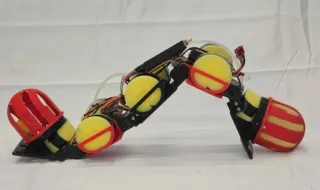
Modern robotics continues to draw inspiration directly from nature, creating amazing machines that blur the lines between biology and mechanics. Scientists at the Tandon School of Engineering at New York University have unveiled an impressive new prototype called WorMa — a soft worm-shaped robot whose unique ability to move is based on transferring fluids inside its structure.
The innovative machine is half a meter long and weighs just over a kilogram, with its structure consisting of five connected segments, driven by four precision joints. The real engineering trick, however, lies in the placement of two latex water tanks located at either end of the body — in the head and in the tail. Using a centrally located pump, the robot can dynamically move about three hundred grams of water between the tanks, instantly changing its center of gravity relative to the terrain.
This hydraulic balancing system gives the robot exceptional adaptability in different environments. When climbing steep slopes of up to nineteen and a half degrees, the water mass is pumped to the head, which sharply increases traction with the surface. When the machine enters a water basin, the weight is transferred back to the tail, increasing swimming speed by more than a quarter. When passing over vertical obstacles such as steps up to fifteen centimeters high, WorMa rhythmically changes its ballast to stabilize the front part and pull the rest of the body up.
Despite its serious potential for exploring complex coastal and hard-to-reach areas, the development is still at an early stage. In its current version, the robot does not have its own environmental sensors, which requires external control of water flows. The research team's future plans include increasing the pump's flow rate and full autonomy, thanks to which the mechanical worm will recognize the type of terrain and decide how to distribute its weight. See more in the video.