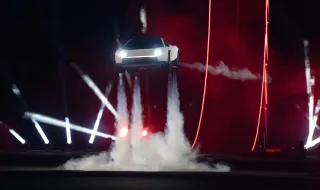
Five seconds of operation of the accelerators can leave the new Tesla Roadster without this function for between two and six hours. That's how long it takes to refill the compressed nitrogen tank, Tesla's vice president of engineering Lars Morawi revealed. “Currently, the charging time is between two and six hours. We hope to reduce it to under half an hour“, said Morawi. The system uses a 200-liter tank that must be filled to a pressure of up to 10,000 psi.
When activated, the compressed nitrogen is released in a short, strong pulse and helps accelerate the car. The technology is known as cold gas thrust and uses a principle similar to that of small spacecraft maneuvers. In the Roadster, it is designed to provide a short-term boost during acceleration from a standstill. The pressure required means that a regular compressor will not be enough. Specialized equipment will probably be needed for charging, which raises an additional question for future owners - where and how the tanks will be filled.
Tesla presents the new Roadster in three configurations. The base Performance is a two-seater and is described as a version for driving on the road without cold gas accelerators. The Thrust version retains the two-seater compartment, but receives rear accelerators. It is designed for demonstrations of strong acceleration and short jumps. There is still no final confirmation of full homologation for driving on public roads. Rocket is a single-seater configuration with accelerators around the car.
It is presented as a version for controlled demonstrations and is not approved for driving on public roads. The indicated reservation for Performance is $ 50,000, and for Thrust - $ 250,000. Both versions require a $5,000 credit card down payment, with the balance due within 10 days. Tesla has yet to confirm final specifications, pricing, or delivery dates. Production is expected to begin in 2028, but that date is subject to change. By then, the company will have to figure out not only how to shorten charging times but also how to provide the necessary infrastructure for cars with accelerators.