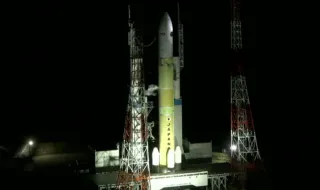
The space industry has entered a new chapter in its development after Japan successfully launched the MMX interplanetary probe, which aims to carry out the first-ever mission to collect and return valuable samples from a Martian moon back to Earth. The large-scale space event took place on October 20, when a powerful H3 carrier rocket took off from the launch complex at the Tanegashima Space Center. Although the launch marks only the first step of a long journey, the entire expedition requires precise planning and years of hard work before the capsule touches down on its native land again.
The development of the cutting-edge device is the work of the Japanese Aerospace Exploration Agency JAXA, which has set extremely complex and ambitious tasks for the engineering team. According to the current mission schedule, the MMX probe should reach the orbit of the Red Planet in 2027. Within three years, the device will study in detail the two natural satellites of Mars - Phobos and Deimos. The unprecedented study of the surface of the larger satellite Phobos will use a specialized miniature rover called IDEFIX, whose main task is to analyze the terrain on site and select the most suitable safe points for a future landing.
The culmination of the interplanetary odyssey is planned for late 2028 or 2029, when the probe is to land on the surface of Phobos twice to take samples of rocks and dust. The operation itself will be extremely risky and technically complex due to the extremely weak gravity of the Martian moon and the extremely uneven and rocky terrain. After collecting the necessary scientific material, the spacecraft will head back home in November 2030, with the mission scheduled to end in 2031 with a parachute landing of the special capsule in the desert regions of Australia.
The main scientific goal of this historic expedition is to provide a definitive answer to long-standing disputes among astrophysicists about the origin of Phobos and Deimos. According to leading scientific hypotheses, the two bodies either formed from giant debris after an ancient massive collision with Mars, or are old asteroids captured by the planet's gravitational field. Laboratory analysis of the samples delivered to Earth will allow scientists to decipher the chemical composition and reveal the secret of their formation.