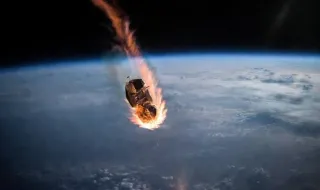
The Russian satellite “Rassvet-3“ No. 17 burned up in the dense layers of the atmosphere on October 30, after failing to raise its orbit. The device has the NORAD identifier 100083 and was launched on July 19 with a “Soyuz-2.1b“ rocket along with 15 other satellites from the “Rassvet“ system.
The entry into the atmosphere was reported by Defense Express and UNIAN. The data coincides with the forecast of the American Aerospace Corporation, which expected the satellite to descend on October 30 with a deviation of several hours. The device did not perform any observable orbital lift after separation from the rocket, and the residual atmospheric drag gradually lowered its altitude.
This is the second serial satellite from the group to be lost in the same way. On June 6, “Rassvet-3“ No. 4, launched in March as part of the first serial batch of 16 devices, left orbit. Thus, out of a total of 32 serial satellites launched in 2026, 30 remain in orbit.
What is happening to the remaining satellites
According to Defense Express, about 26 of the remaining devices have reached an altitude of approximately 500 kilometers. Several more continue to perform orbital maneuvers, and satellite No. 23 from the second batch has begun to increase its altitude, after being about 220 kilometers away on October 20.
Initially, a target orbit of about 800 kilometers was specified for the “Rassvet“ system. However, discovered data on the movement of the devices show that the main group is currently concentrated around 500 kilometers. Defense Express assesses this as an intermediate stage of the deployment, and not as evidence of the final failure of the project.
Back in July, the press secretary of “Bureau 1440“ told the Russian media: “After the completion of the checks and commissioning, the satellites will move to the target orbit“. The company has not published an official statement about the loss of device No. 17, and public data on the status of individual satellites is based mainly on catalogs and space observation systems.
The project continues, but with a new loss
„Rassvet“ is being developed by the Russian company „Bureau 1440“ as a low-orbit network for broadband satellite Internet, comparable to the American Starlink system. In 2026, two serial launches were carried out with a total of 32 devices. The company plans to begin commercial operation in 2027.
The burning of No. 17 reduces the number of serial satellites and shows that some of the devices from the second batch were unable to perform the necessary maneuvers to reach a higher orbit. There is currently no publicly announced date for the next batch launch to compensate for the loss or expand the group.
Sources: defence-ua.com, unian.net, www1.ru