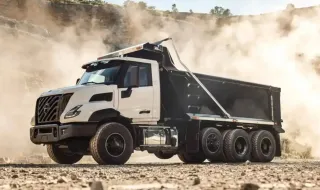
Volvo Trucks has officially unveiled the all-new Volvo VNX – a super-heavy-duty model designed from the ground up to work in the harshest and most critical operating conditions in North America. This debut marks another technological triumph for the Swedish brand, making it the third all-new truck for the North American market in less than three years, following the success of the VNL and VNR.
The new Volvo VNX is specifically aimed at the most demanding sectors, including large-scale construction, logging, agriculture and specialized oversized-load transport. Peter Voorhoeve, President of Volvo Trucks North America, describes the model as the toughest, safest and most durable specialized truck ever created by the brand. At its core is a reinforced, heat-treated high-strength steel frame designed to withstand a combined gross weight of 73 tonnes, while with special approval from the manufacturer, its capacity can reach a record 91 tonnes.
All powertrain variants rely on the proven Volvo D13 engine, generating a maximum output of 540 horsepower and an impressive 2,600 newton-metres of torque. Among the innovative solutions designed to boost productivity is a remote low-speed motion control function of up to 8 km/h. This allows the driver to manoeuvre the vehicle precisely from outside, providing an invaluable benefit when operating specialized equipment such as concrete mixers, construction cranes and vacuum systems.
The Volvo VNX enters the market with a choice of three main cab configurations: a short day cab, a compact sleeper cab and a flagship sleeper cab approximately 160 centimetres long. The first two configurations are available both as tractor units for semi-trailers and as specialized chassis for bodywork, while the most spacious sleeper-cab version is reserved exclusively for tractor units.