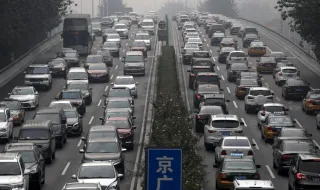
Massive investments in infrastructure never lose momentum, and when it comes to transport ambitions on a planetary scale, attention invariably turns to the eastern markets, where ambitious plans become reality with astonishing speed.
State institutions in the world’s most populous country are drawing up ambitious plans for the next five-year period, covering the years from 2026 to 2030, during which the country has decided to rewrite the rules for mobility and logistical connectivity across its vast territory.
An official statement by Xia Xin, who holds the responsible position of head of the Infrastructure Development Department at the National Development and Reform Commission, sheds extensive light on the Beijing government’s grand intentions for the coming years.
According to the official data presented, during the forthcoming five-year period the country will build an impressive 21,000 kilometers of new expressways, which will effectively put the finishing touches on the creation of a comprehensive and modernized road system.
However, this massive project is far from being limited to asphalt arteries, as alongside them the state apparatus plans to increase the total length of railway lines by another 15,000 kilometers, with two-thirds of them intended for high-speed traffic.
The senior official emphasizes that the government’s main strategic priority is to guarantee seamless connectivity across the national transport network, removing all logistical barriers between individual regions and economic centers.
During the same period, construction forces and specialized companies will direct substantial resources toward the accelerated construction of riverside expressways, as well as key ring roads around major metropolitan areas, where traffic traditionally reaches critical levels.
The plan also calls for the targeted expansion of capacity along the busiest transport corridors, large-scale development of regional rural roads, and mandatory modernization of strategic border and coastal sections across the country.
Particular attention has been devoted to the complex geographical zones, among which are the important road arteries leading west from the Xinjiang autonomous region all the way to the rugged high-altitude territories of Tibet.
Alongside road transport, the railway sector will undergo a genuine technological revolution over the next five years, as the state is actively developing a comprehensive system of new standards for trains capable of reaching uncompromising speeds of up to 400 kilometers per hour.
Beijing’s authorities are adamant that the focus will not be solely on raw speed, but on commercial efficiency, eliminating bottlenecks across the network, and optimizing freight transport through the creation of a fully specialized railway logistics network.
As part of this strategy, new freight trains are planned to enter service, maintaining operating speeds of up to 200 kilometers per hour and optimizing the distribution of goods between major logistics hubs nationwide.
These ambitious moves build on an already solid foundation, with official statistical data indicating that by the end of 2025 the total length of expressways in the country will have reached an impressive 199,400 kilometers, while the railway network will extend over 165,000 kilometers.