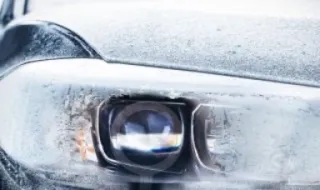
A light haze on the inside of a headlight does not necessarily indicate a defect. The ventilation openings are part of the light assembly’s design and allow pressure to equalise. When the warm air inside the headlight meets the cold inner surface of the lens after a car wash, rain or overnight cooling, moisture can turn into fine droplets.
With a properly functioning headlight, the fogging usually disappears after the lights are switched on or while driving. If the headlight still appears heavily fogged around 20 minutes after the start of the journey, there is probably a reason for inspection. Manufacturers’ technical guidelines use a similar criterion: a fine haze may be normal, but puddles, streaks from water running down and large droplets point to water ingress or a sealing problem. The easiest way to dry the headlight is to leave the lights switched on for several minutes. The outer side of the lens can also be carefully warmed with a hairdryer or a heat gun on a low setting. Another temporary option is to place a silica gel packet behind the bulb access cover, but it must be removed after drying.
If the condensation returns within a day or two, the housing’s ventilation opening should be checked. Dirt can be removed carefully, but blowing compressed air into it carries the risk of forcing dust and other particles inside the headlight. Persistent moisture may be caused by a worn seal on the bulb access cover, a crack in the housing or a compromised connection between the front lens and the housing. The cover seal can usually be replaced relatively easily. Repairing the light assembly itself is more complicated, as many modern headlights are not designed to be disassembled.
Drilling additional openings is not a solution, although it is sometimes recommended as a temporary measure. It does not eliminate the point through which water is entering and may worsen the protection of the electrical components.