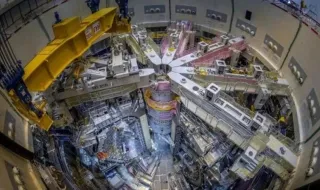
An interesting experiment in the field of nuclear energy marks an important milestone after tests of one of the world’s most massive superconducting magnet coils were successfully completed as part of the large-scale international ITER project (International Thermonuclear Experimental Reactor). The component in question is the impressive toroidal field coil No. 17, whose weight reached an astonishing 330 tonnes. The facility was subjected to extreme thermal and electrical loads, being cooled to absolute zero minus 269 degrees Celsius, or 4 kelvins, and powered with an operating current of 34,000 amps. This test represents a key step before the reactor’s final assembly, when any mistake could prove fatal for the entire multibillion-dollar project.
The 34-kiloamp current used in the tests actually represents just half of the design maximum capacity, which will reach 68 kiloamps under real-world conditions. Engineers are facing a challenge unprecedented in the history of science, as devices of this kind have never before operated under such extreme parameters. The behaviour of the superconducting materials, the structural deformations that arise, the durability of the connections and the response to possible partial heating have so far been analysed solely through computer simulations. Once the reactor is finally assembled in the underground shaft, corrections will no longer be possible, and success will become the researchers’ only option.
These precise assessments are being conducted using the specialised Magnet Cold Test Facility, which enables the individual components to be tested in isolation before they are integrated. Thanks to the facility, experts were able to measure the actual displacement and deformation of the 330-tonne structure under the influence of enormous electromagnetic forces, comparing them with preliminary mathematical models. Before this phase, coil No. 7 was tested at the same site under lower parameters of 10 kiloamps, allowing the teams to calibrate the systems for early detection of a superconducting quench and to check the resistance of the electrical connections.
The preparation and testing process for coil No. 17 itself was completed at the end of October, after which it was moved to storage pending its place in the overall structure. The reactor’s architecture calls for a total of 18 giant toroidal elements, six poloidal coils and a central solenoid, whose magnetic field is powerful enough to hold an entire aircraft carrier in place. Production of these unique components is distributed among different countries around the world: the central solenoid, for example, was manufactured in the United States, while one of the largest poloidal coils comes from Russia.
The plan going forward calls for the reserve toroidal coil No. 19 to be the next subject of extreme testing. Its cooling to 4 kelvins is scheduled for spring 2027. Initially, it will be tested at the same current of 34 kiloamps, followed by a full load of 64 kiloamps. This will allow engineers to verify the reliability of the high-voltage insulation and assess the risks of mechanical deformation when operating in ultra-strong magnetic fields, which is why the component will also receive an additional reinforcing frame. In addition to the standard procedures, this reserve coil will undergo targeted thermal stress tests aimed at identifying the absolute safety limits of superconductivity.
Despite the progress in testing, the large-scale international project is alarming investors with serious delays compared with the original schedule. Initial plans called for scientific operations to begin as early as 2024 and the first plasma to be produced in 2025, but these deadlines have been pushed back to 2034. The accumulation of technological difficulties, pandemic restrictions, delays in logistics chains and the need to eliminate serious defects in the vacuum chamber and thermal shields forced management to redraw the timetable.
The initial experiments at the site will begin with more conventional hydrogen and deuterium plasma, representing a more cautious approach than originally intended. According to current estimates, reaching the full design plasma current of 15 mega-amperes is scheduled for 2036, while the real breakthrough with a deuterium-tritium mixture is planned for 2039. At that point, the reactor is expected to demonstrate a fusion power output of 500 megawatts with 50 megawatts of input plasma heating, providing the desired energy gain factor of ten times the energy supplied, albeit four years later than initially forecast.