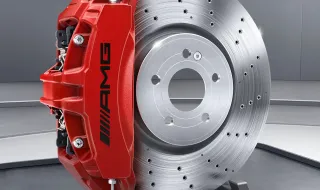
The Stuttgart-based group is throwing down the gauntlet to one of the most conservative components in automotive engineering by presenting an innovative concept for a braking mechanism integrated directly into the electric drive module.
Traditional ventilated discs and wheel-mounted brake calipers face a serious challenge in modern electric vehicles, where regenerative braking handles more than 90 percent of everyday deceleration, leaving mechanical components exposed to corrosion and uneven wear.
The Mercedes-Benz engineering team is addressing this problem by fundamentally rethinking the architecture, moving the friction elements from the wheel hubs inside the gearbox and electric motor housing itself.
The new system uses a wet multi-plate clutch pack in an oil bath, positioned directly on the drive unit shaft, whose operation is controlled with surgical precision by electrohydraulic actuators and a high-efficiency water heat exchanger.
Thanks to the enclosed design and constant circulation of coolant, thermal loads are transferred instantly to the vehicle's main radiator, completely eliminating the risk of overheating or brake fade during prolonged descents.
One of the most significant advantages of this packaging solution lies in the drastic reduction of unsprung mass in the suspension, allowing the dampers to respond much more quickly to road irregularities and improving handling.
At the same time, the system acts as a natural trap for the fine particulate matter released through friction, preventing it from being discharged into the atmosphere and easily meeting the strictest environmental requirements of the Euro 7 standard.
Clearing the space behind the wheels also paves the way for fully enclosed aerodynamic covers without the need for cooling openings, reducing aerodynamic drag and adding valuable kilometres to the vehicle's real-world driving range.