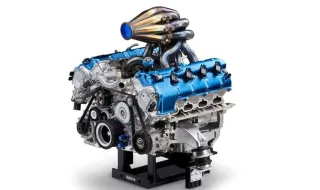
Engineers working on internal combustion engines continue to search for alternative ways to ensure their survival, with Japanese giants Yamaha and Toyota joining forces to develop an advanced hydrogen-powered engine with a five-liter displacement and a V8 architecture.
The project is based on a solid engineering foundation borrowed from the Lexus RC F sports model, but is now undergoing another major revision of its key components to adapt them to the specific physical properties of gaseous fuel.
At the heart of this technical evolution is an entirely new combustion chamber with eight independent variable-length intake manifolds, which optimize airflow velocity and ensure precise, homogeneous mixture formation under high loads.
Yamaha's engineers have fundamentally redesigned the cylinder head, incorporating specially developed high-pressure direct-injection injectors, as well as reinforced valves with improved heat resistance.
The dynamic characteristics of the eight-cylinder beast are impressive, with the engine developing a maximum output of 450 horsepower at 6,800 rpm and peak torque of 540 Nm.
Particular attention has been paid to the exhaust system, whose manifolds are formed into a specific equal-length bundled configuration, creating a unique acoustic signature that fully matches that of traditional sport-oriented gasoline engines.
Although the project is still at the stage of experimental bench testing and trials, it demonstrates in practice that hydrogen combustion can offer environmental cleanliness without sacrificing the classic mechanical character.
As of today, the hydrogen V8 concept continues to be developed primarily within research and motorsport programs, with Japanese automaker Toyota actively testing hydrogen internal combustion engines on the track in the Super Taikyu series, refining both liquid-hydrogen systems and software controls to achieve optimum efficiency.
Although mass production of such engines still faces serious barriers related to the lack of an established refueling infrastructure, the project remains a living symbol of the desire to preserve the excitement of classic mechanical propulsion in an environmentally responsible world.