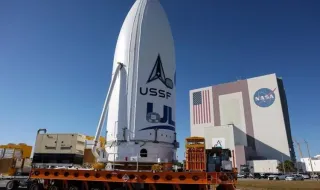
United Launch Alliance’s Vulcan rocket failed to place 40 Amazon Leo internet satellites into orbit after launching from Florida. The anomaly occurred approximately 10 minutes after the start of the flight, and the entire payload was lost.
Vulcan lifted off from Launch Complex 41 at the “Cape Canaveral” Space Force Station on November 15 at 12:40 p.m. local time, or 5:40 p.m. Greenwich Mean Time. This was the rocket’s first mission for Amazon Leo and Vulcan’s fifth flight.
“Based on data received from the launch director, we confirm that the Vulcan rocket, launched from Launch Complex 41, experienced an anomaly 10 minutes after the start of the flight and was unable to place the Amazon mission into orbit,” United Launch Alliance said.The company added that it would work with Amazon and other organizations to determine the cause, identify the necessary corrective actions, and prepare Vulcan to return to flight. ULA has not yet publicly indicated which component caused the failure.
What happened during the flight
The rocket was equipped with two BE-4 methane engines manufactured by Blue Origin and six Northrop Grumman solid-fuel boosters. The boosters operated normally during the first few minutes and separated approximately one minute and 40 seconds after liftoff.
According to data analyzed by Ars Technica, the two first-stage engines continued operating for at least 30 seconds longer than expected. After first-stage separation, the rocket began to spin, and the Centaur upper-stage engines ignited while the vehicle was visibly deviating from its planned trajectory.
Initially, ULA only stated that an anomaly had occurred. The exact sequence of events and the technical cause will be clarified as part of the investigation.
Consequences for Amazon’s program
The lost mission was the first of a total of 38 launches booked by Amazon on Vulcan rockets to deploy satellites for the Leo network. The company has also contracted 24 flights on Blue Origin’s New Glenn rocket, 24 on the European Ariane 6, and 13 on SpaceX’s Falcon 9.
More than 3,300 satellites are required for the initial Amazon Leo constellation. Before the failed flight, Amazon already had satellites in orbit, but the loss of 40 spacecraft reduces the planned pace of the network’s deployment.
Amazon Leo said that risk exists with every launch, especially during a first mission with a given configuration. “ULA is a longstanding partner of Amazon, and we believe the company will draw the necessary lessons from this mission and carry out its long-term plans for Vulcan,” Amazon Leo said.
What comes next
A technical investigation of the telemetry data and the rocket’s behavior during the flight will follow. Vulcan will likely remain grounded until the cause is identified and corrective measures are implemented.
Until the mission was lost, ULA had not experienced a complete rocket failure since its creation in 2006. Before this flight, the company had postponed three consecutive attempts due to problems with ground systems and technical interruptions during the countdown.
Sources: cbsnews.com, spaceflightnow.com, arstechnica.com