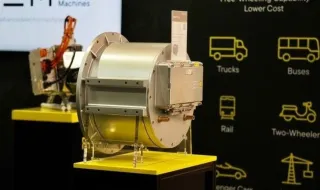
Expensive raw materials from distant parts of the world have long been the Achilles’ heel of modern electric mobility, but it appears that the end of this technological monopoly may be in sight. British technology company Advanced Electric Machines, known in the industry as AEM, threw down the gauntlet to traditional automotive engineering at the prestigious IAA Transportation 2026 exhibition in Hanover. There, the company unveiled the impressive specifications of its latest electric motor, the Titan, designed specifically for the heavy transport industry.
At the heart of this engineering breakthrough is the complete elimination of permanent magnets, whose production typically requires scarce rare-earth metals. Instead of relying on expensive and hard-to-source resources, the British specialists have opted for far more readily available alternatives such as steel and aluminium. What is more, the ambitious team is working hard to completely eliminate copper from its power units, although for now the exact operating principle of its patented HDRM technology remains a closely guarded secret.
Despite the absence of traditional expensive components, the Titan’s raw figures are enough to make many competitors raise an eyebrow. As the largest and most powerful member of the HDRM range, the new unit develops a peak output of 700 kW, equivalent to an impressive 952 horsepower, accompanied by a colossal torque of 5,000 Nm. Under sustained and continuous load, as experienced in the daily operation of heavy trucks, the motor maintains a steady 500 kW (680 hp) and 3,500 Nm. All this is achieved at a maximum speed of 4,000 rpm and an astonishingly low weight of just around 200 kilograms.
To extract such a high specific output from such a compact body, the engineers have incorporated an innovative dense-winding architecture combined with an advanced cooling system. The extruded housing allows the length of the unit itself to vary according to requirements, while the flexible design enables the installation of a wide range of output shafts. In this way, the Titan can be seamlessly integrated into the drivetrains of a broad range of heavy machinery and specialised equipment.
The absence of permanent magnets also brings a number of operational advantages that effectively solve longstanding problems in the sector. According to its creators, the unit is completely immune to the risk of demagnetisation at extreme operating temperatures and high speeds. The built-in freewheeling mode allows the vehicle to coast without generating unnecessary resistance or torque, while the specific design smooths out the torque pulsations characteristic of some electric motors.
From a safety and integration perspective, things also look promising, as the development is compatible with a variety of inverters on the market. AEM emphasises that in the event of a possible technical failure, the motor generates neither dangerous short-circuit currents nor harmful back electromotive force. For now, the only question mark concerns the exact efficiency coefficient of the new unit, which the British company is still keeping under wraps.
As of today, the innovative Titan exists solely as a detailed three-dimensional digital model, but plans to bring it to life are quite concrete. The first real prototypes for testing are expected to be ready and delivered to partners in the third quarter of 2027.
Advanced Electric Machines itself began its journey in 2017 as a research project at Newcastle University and quickly established itself as a pioneer in magnet-free electric motors. The achievements of the British company have not gone unnoticed by investors and industry: very recently, the firm secured two key contracts to develop drivetrains for passenger cars and managed to attract fresh capital of £16 million, or approximately $21.2 million, to develop its next-generation technologies.