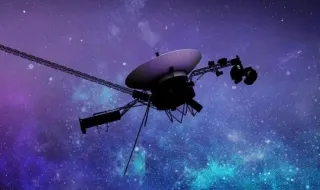
Few would have believed half a century ago that electronics from the 1970s would survive for so long in the icy wasteland beyond the Solar System. On November 18, 2026, at 13:16:07 Moscow time, the Voyager 1 spacecraft marked a remarkable distance milestone by crossing the boundary of one light-day from our planet. Reaching this point took 49 years, two months, and 11 days after its launch on September 5, 1977, and the most impressive aspect is that the veteran is far from being a silent piece of debris—it continues to transmit scientific data.
Before we get into the calculations, it is worth clarifying the concept itself – a light-day is a measure of distance, not time. It denotes the distance that light and any other electromagnetic radiation travel in 24 hours, which amounts to approximately 25.9 billion kilometers. In practice, this means that radio waves traveling at the speed of light now need about 24 hours to reach the probe from Earth, and another 24 hours for the return signal. The spacecraft itself naturally does not travel along a perfectly straight line, so its actual distance traveled and any readings from a hypothetical odometer would be different.
Today, Voyager 1 is moving relative to the Sun at around 61,000 km/h (37,000 mph), but even at this impressive pace, cosmic scales remain almost unimaginable. According to NASA calculations, it will take nearly 40,000 years to approach within about 1.7 light-years of the star Gliese 445 (AC +79 3888), which is more than 17 light-years from Earth. A time horizon at which human history appears like the blink of an eye.
The spacecraft's original task was to study the giants Jupiter and Saturn, but in August 2012 it crossed the heliosphere's boundary and entered interstellar space. Since then, the probe has been studying the environment beyond the solar bubble of charged particles and magnetic fields. Keeping such ancient technology operational requires genuine engineering acrobatics – the NASA team has been successively switching off less important scientific instruments and conserving energy even from critical components such as the heating systems for the fuel lines leading to the engines, in order to extract every possible watt from the aging power sources.
Its younger companion, Voyager 2, is also traveling through interstellar space, but it will not reach a distance of one light-day from Earth until November 2035. Both probes carry the famous gold-plated records containing sounds, music, images, and greetings in various languages – a kind of message in a bottle cast into the cosmic ocean toward possible extraterrestrial civilizations.
An intriguing detail about these artifacts is that three records were originally produced – one for each spacecraft and one spare. NASA subsequently planned to launch ten more similar probes, which led to the creation of at least ten additional copies. Today, replicas are kept at iconic locations such as the Library of Congress, the Smithsonian Institution, the United Nations, and a number of NASA centers, while Elon Musk once mentioned that he owned such a disc, without specifying whether it was an original or a copy.