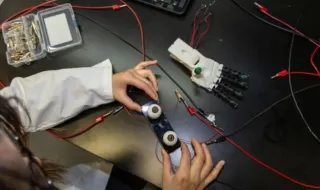
The clumsiness that has long characterized machines may soon be a thing of the past, after researchers at the University of Pennsylvania developed a new generation of artificial muscles called CoilLCE. The innovative actuators give robots unprecedented fine motor control, enabling them to perform exceptionally delicate and realistic movements.
During laboratory demonstrations, a robotic hand confidently played a series of piano notes, while a pair of artificial eyes recreated the smooth and natural movement of the human gaze. At the heart of the breakthrough is a carefully selected combination of materials – liquid-crystal elastomers, graphene and an ultrathin copper coil.
The operating principle resembles that of real biological tissue: when heated, the elastomer contracts, and when cooled, it returns to its original length. Adding graphene to the structure makes the composite both softer and significantly more resistant to stress, while the embedded copper wire serves a dual purpose – it heats the fiber and simultaneously tracks every change in its position.
This self-regulation solves the biggest challenge facing existing soft robotic systems. Elastomers generally have difficulty holding an intermediate shape and require complex external control to prevent them from relaxing or tightening excessively.
The scientists overcome this limitation by measuring the electrical resistance of the copper coil itself and adjusting the heat supplied in real time. As a result, the muscle can literally sense its own state and lock into a precisely defined position without the need for additional bulky sensors.
To achieve maximum realism in the artificial-eye demonstration, the engineers borrowed the design directly from human anatomy. The eyeballs are driven by four pairs of muscle fibers that work in opposite directions – when one contracts, the opposing one relaxes, ensuring smooth aiming and gaze stabilization without unnecessary strain on the system.
According to the research team, the development paves the way for a new generation of humanoid robots capable of rich and natural facial expressions, as well as precise finger manipulations.
In the next stage of the project, the researchers intend to integrate artificial intelligence and computer vision algorithms to coordinate dozens of similar muscles in complex and fully autonomous movements.