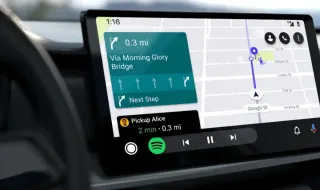
Google has begun the gradual rollout of Android Auto 18.2.664604-release, which changes the way the system looks on wide horizontal car screens. Instead of the navigation bar at the top, the main functions are now arranged in a vertical menu along the side of the display.
The change is most noticeable in music apps. In Spotify, for example, the “Library” and “Browse” buttons have been moved to a side column, while less unused space remains between the album artwork and the edge of the screen. A larger now-playing bar has also been added, with visible artwork and more accessible buttons for pausing, changing tracks and controlling content.
The new design is appearing progressively in Spotify, YouTube Music, Amazon Music and the dialer app. The idea is for the controls to be closer to the driver’s natural line of sight, rather than requiring them to reach toward a distant corner of the large central screen. This is particularly important in vehicles with displays that occupy a significant portion of the dashboard.
The update is part of Android Auto’s broader transition to the Material 3 design language. Google announced in May that the new experience would be adapted for an “ultrawide rectangle, circle or unique shape” of the car’s screen. The company also said that Android Auto is now compatible with more than 250 million vehicles, making adaptation to different configurations important for a large number of drivers.
As examples of cars with unusual displays, ArenaEV cites the Honda e Advance, with a panoramic screen stretching across the dashboard, as well as the Mini Cooper with a circular central display. In such configurations, the old top menu often left large empty areas and looked like a stretched version of a phone interface. Vertical side navigation allows the main content to make fuller use of the available width.
The new version is not reaching all devices at the same time. Users may receive the interface the next time they connect to their car, but for others the update may appear later, as the rollout is being conducted in stages. Google also maintains a beta program through which some users receive new features before their wider release, but the company warns that test versions may be less stable.
The question remains how the menu will behave in right-hand-drive cars. If the side column is fixed on the left with no option to change it, drivers in the United Kingdom, Australia and other countries where traffic drives on the left will have to reach across a larger portion of the central screen. The submitted material contains no confirmation as to whether the new version already uses the traffic-side setting reliably.