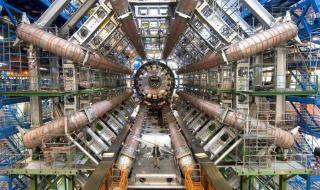
On September 10, 2008, the Large Hadron Collider was put into operation in Geneva. It is considered the largest scientific experiment in the history of mankind.
The Large Hadron Collider (LHC) is the largest and most powerful collider (particle accelerator) in the world. It is located at the European Center for Nuclear Research CERN (Centre europeen de recherche nucleaire).
It is designed to accelerate colliding beams of protons and heavy ions. The goal of the LHC project is primarily to discover the Higgs boson — the most important elementary particle predicted theoretically by the Standard Model (SM), but not yet observed experimentally. It is planned to pay attention to the study of the properties of the W and Z bosons, nuclear interactions at ultrahigh energies, and the processes of creation and decay of heavy quarks (b and t).
In 2012, the cherished goal was reached - the Higgs boson was discovered.
The Large Hadron Collider is located at the European Organization for Nuclear Research (CERN), 91.44 meters below the French-Swiss border. The idea was conceived in 1984, but was approved only two decades later, as the financial flows with which the LHC would be built were gradually negotiated.
It involves electromagnets with coils of superconducting material that send a beam of mini-atomic particles around the Earth, with a circumference of 27 km. The electric fields charge the particles at speeds close to that of light, and their collision produces a super-explosive heat that heats up the space to 100 million degrees Celsius, which is actually the temperature that was reached a trillionth of a second after the big bang.
An interesting detail is that by February of In 2015, the large particle accelerator held 10 Guinness World Records, and they are still growing. My estimate for that was around 22 million euros per year, and it will probably grow over time.