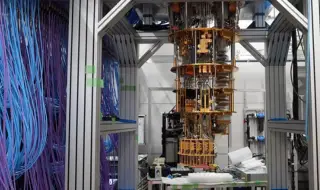
Japan has made significant progress in the field of quantum technology with the launch of the world's largest quantum computer using superconducting qubits. The system is the result of a joint effort between technology giant Fujitsu and leading research institute RIKEN, who have been collaborating on the development of quantum computers since 2012.
In March 2023, the partners unveiled Japan's first national 64-qubit quantum computer, promising at the time to increase the number of qubits to 100 by 2025. Now, however, they have surpassed their own expectations, presenting a system with an impressive 256 qubits – an achievement that positions it as the largest quantum computer in the world to date.
Innovative architecture for record-breaking performance
The Japanese engineers achieved this record-breaking performance thanks to a new architecture for superconducting quantum processors. Key innovations include:
Microcluster organization: Qubits are organized in cells of four.
Three-dimensional structure: The cells are built not only in a row, but also in the form of a multi-level or three-dimensional structure, while also taking into account the challenges associated with heat dissipation.
This increased qubit density allows the integration of a 256-qubit processor in the package of the previous 64-qubit system. According to experts in the field, this paves the way for further scaling of quantum superconducting processors – a task considered one of the most difficult in creating a practical, universal, and fault-tolerant quantum computer.
Progress toward a million qubits
Most scientific studies indicate that creating a practical, fault-tolerant quantum computer requires a platform with at least one million physical qubits. The Japanese researchers believe that the new cluster and three-dimensional architecture demonstrates the possibility of approaching this desired goal within reasonable spatial constraints for quantum systems.
Connectivity challenges and future prospects
One of the key challenges in scaling quantum computers is related to the high density of signal and control cables required to operate the qubits – reading, programming, and correcting errors. The 256-qubit computer from Fujitsu and RIKEN has achieved the same high density as quantum systems from Google and IBM.
A typical quantum computer with superconducting qubits often resembles a complex chandelier, strewn with numerous input and output cables with high-frequency connectors. This is because working with superconducting qubits requires microwave (radio frequency) signals for non-destructive reading. Add to this the careful shielding of each signal wire, and it becomes clear why cable bundles make scaling difficult.
One potential solution is to move the control electronics inside the cryogenic chamber, close to the qubits. Unfortunately, semiconductors cannot yet withstand such extreme low temperatures. All this is a matter of future development. In the meantime, hybrid platforms are being created where conventional supercomputers control the qubits. Europe is noted to be lagging behind the US and Japan in terms of installing high-density interfaces for superconducting quantum computers.
Access and future promises
The 256-qubit computer from Fujitsu and RIKEN is now available to customers via a cloud platform around the world. However, access is likely limited to a select group of customers, whose names are being kept secret. The goal is to test ideas and look for problems that quantum computers can solve at their current level of development.
In the new year, Fujitsu and RIKEN promise to present a 1,000-qubit platform, which will be another step towards realizing the dream of a universal fault-tolerant quantum computer - a system that can be billions of times better than classical computers at a number of tasks