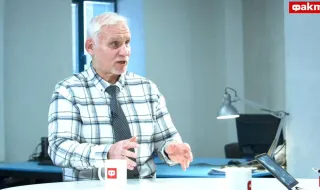
The meeting in China sets the tone. The dialogue itself is extremely important, as you will remember the tension literally before the meeting between Trump, Putin and Xi. It had been planned earlier, but until it was announced, the tension could be cut with a knife. The meeting makes a great deal of sense – the tension has eased. Prof. Nako Stefanov, a Doctor of Philosophy and a Doctor of History, and a lecturer in the Department of East Asian Languages and Cultures at Sofia University „St. Kliment Ohridski“, said this to Lili Marinkova in the „FAKTI“ studio and on the „Conversation“ program.
„Despite the meeting in Berlin and the opinions and conclusions drawn from it, we are still talking about relations between the three great powers. Here in Bulgaria, it is being said that there are two and a half major powers, that Russia is a half-power, while the great powers are the US and China. I do not agree with this rhetoric,“ he said.
„The countries are equal not only in military terms. Russia has the largest number of nuclear warheads, but even if the difference is several thousand, that makes no difference whatsoever. Everyone claims that Russia is a small economy compared with the US and China. But in my view, that is not the case either. Let me give you an example. The US has enormous debt. The federal debt alone exceeds 40 trillion dollars, while total debt exceeds 100 trillion dollars. China also has enormous debt. Russia, however, has a debt amounting to just 17% of its gross domestic product. China's debt is also very large. It is concentrated more in the various provinces and corporations, but this affects China as a whole. This debt has been growing very rapidly in recent years,“ he commented.
„Russia is a highly self-sufficient country. This was also evident in the war in Ukraine. This war not only failed to weaken it, but did exactly the opposite – Russia began developing things it had previously only purchased. Russia produced photolithography machines for manufacturing microchips. Their feature size is very large, at around 100 nanometers. Taiwan and South Korea are currently competing to achieve two nanometers. But when it comes to heavy missiles, it makes no difference whether we are talking about 100 nanometers or two nanometers,“ Prof. Nako Stefanov stated.
„So Russia is highly self-sufficient in terms of food, water and resources, while neither the US nor even China is as self-sufficient. From this perspective, this self-sufficiency is a particular strength that makes it one of the superpowers. That is why I disagree with the opinion that Russia is a small economy and amounts to nothing. This is absolutely untrue. It has a substantial economic base and a substantial economy,“ he added.
Watch more of the conversation in the VIDEO.