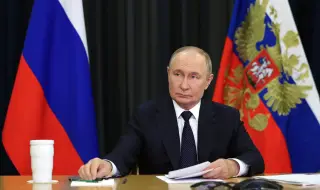
Sergey Aleksashenko is a well-known Russian economist and former Deputy Minister of Finance of Russia. Since 2013, he has lived and worked in the United States. In 2023, he was declared wanted after the Russian Ministry of Justice included him in the list of “foreign agents“.
DV: Sberbank CEO German Gref sees the Russian economy in stagnation, and Economic Development Minister Maxim Reshetnikov believes that the Russian economy is cooling faster than expected. However, President Putin disputes these assessments and claims that everything is fine. What is your assessment: what is happening in the Russian economy?
Sergey Aleksashenko: Literally from the first days of the war in Ukraine, there was constant talk that the Russian economy would collapse at any moment. However, we see that it has not collapsed yet. In the economy, things are not so clear-cut. For example, the increase in the budget deficit does not mean that the government has no money. It rather shows that tax revenues are insufficient to finance expenses and this must be done through loans. Currently, approximately one fifth of the Russian budget's expenses are financed through loans, and the deficit amounts to 3.7% of GDP, according to data from the Ministry of Finance. It does not sound good, but in the United States the budget deficit exceeds 6% of GDP and approximately one third of budget expenses are financed through loans. That is, if we assume that the budget deficit is a criterion for the state of the economy, then the American one is in much worse shape than the Russian one.
The second question is about the growth rate. What is happening to the Russian economy? In fact, for most experts, it was obvious at the end of last year that the economy was starting to slow down. But here it should be understood that the Russian economy consists of two parts that do not intersect. One is the military economy, where everything is for the front, everything is for victory, and the second is the civilian sector, which does not work for the war. And the fact that the civilian sector is starting to slow down became obvious back in the summer of 2024. Somewhere at the beginning of this year, it turned out that the intensity of growth in the military sector of the economy approximately corresponds to the decline in the civilian one. And in this regard, German Gref's statement that Russia is in a state of technical stagnation is fair, because stagnation is a state of the economy around zero, that is, exactly what we are observing today.
But everything bad that can be said about Putin's economy does not please the president. And the logic here is simple: he himself admitted that the problems in the economy are increasing due to the fact that there is a war. But if the economy is in a bad state, then the war is to blame for this. And isn't it time to end this war?
DV: So, does the problem in the economy actually boil down to a political issue?
Sergey Aleksashenko: Yes. In fact, the dispute is about how to view the slowdown in the economy: as an economic or a political problem? Putin categorically refuses to admit that this is a political problem. At least to the public.
DV: German economist Janis Kluge says that the costs of the war are getting bigger, while revenues from oil and gas are decreasing.
Sergey Aleksashenko: Indeed, the revenues from oil and gas of the Russian Federation in 2025 are less than those from last year. But anyone who wants to orient themselves on this topic knows that revenues from oil and gas depend on two parameters. The first is the price of export oil, which is announced by the Russian Ministry of Economy. And the second is the volume of oil production and exports. Accordingly, we multiply one by the other, not forgetting that the budget is financed not in dollars, but in rubles. A year ago, the dollar was worth 100 rubles, and now it is worth 80. What do you think will happen to revenues if oil production and exports remain unchanged? They are decreasing. But what explains this? Is it that sanctions are working better and that Russia is producing less oil? No. It is explained by the fact that the ruble has strengthened. But the revenues of the Ministry of Finance are indeed less.
DV: Experts unanimously argue that in order to continue the war, Putin will have to cut non-military spending, and this, as a rule, is social spending.
Sergey Aleksashenko: Putin will not cut anything. Last week, at a forum in Vladivostok, he admitted that Russia has problems with budget revenues. And that the deficit is growing. But there is nothing wrong with that. Let's go back to the beginning of our conversation: a budget deficit does not mean that spending should be cut. One does not follow from the other. A budget deficit means that spending should be financed through loans. And can the Russian Ministry of Finance borrow more on the market today? Yes, it can. And there is no problem with that.
DV: From your words, one can conclude that the Russian economy is in a fairly good condition – despite claims to the contrary.
Sergey Aleksashenko: Actually, to experts, it looks bad. Because it is not growing, because economic growth is concentrated in sectors that do nothing useful for society, for the future. This shows that the organism is not healthy. But this does not mean that Putin does not have money to finance social spending, let alone the military.
Therefore, what is happening with the economy does not affect society in any way. At the moment, Russians do not feel the lack of growth.
DV: The European Union is preparing another package of sanctions against Russia. What do you think, do Russians feel the sanctions or have they already adapted and gotten used to them?
Sergey Aleksashenko: Look, both Russians and the Russian economy have adapted to the sanctions for a long time. The Russian economy suffered greatly from the sanctions imposed at the very beginning, in the second quarter of 2022, and suffered a very sharp decline. In the third and fourth quarters of 2022, it was restructured, and since the beginning of 2023, the economy has pushed back from the bottom and started to grow. And since the economy is growing, it means that it has managed to overcome all the existing restrictions that were imposed.
Yes, Russian exporters and importers practically cannot pay in dollars and euros. But they can in rubles, in yuan, in cryptocurrency and in gold. Yes, this may be more expensive, predictability is less and some collapses are possible. But there is an alternative. There may no longer be Toyotas, Nissans, Mercedes, BMWs, etc., but there are Chinese cars and Russian consumers buy and drive them. The population buys other clothes, other shoes. There are no European ones? There are Chinese, Turkish, Vietnamese. They still don't walk naked on the streets of Moscow and other cities. So the Russians have somehow adapted to what is happening and this state of affairs suits them, because there are no riots.
Moreover, I remember that I conducted these surveys sometime at the end of 2022, and even then the Russians did not in any way connect the sanctions with Putin's actions. They believe that the sanctions are malicious actions of the West, which does not love Russia. That is, the connection that the sanctions are a result of the war does not exist in their minds.
Author: Olga Tikhomirova