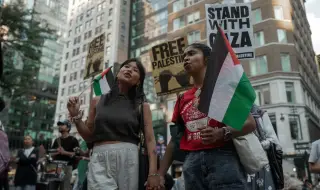
In recent days, a number of countries, including major Western economies such as Britain and Canada, have recognized the State of Palestine. London and Ottawa announced their decision on Sunday, shortly before the conference on the Palestinian issue within the framework of the UN General Assembly. Australia also did so. Yesterday, their example was followed by France and other countries, including Belgium, Malta, Monaco, Luxembourg, Andorra and San Marino. The recognition of the Palestinian state is today a leading topic in the Western press, writes BTA.
The President of France Emmanuel Macron recognized the State of Palestine at a UN summit, thereby prompting other Western governments to take the landmark step that angered Israel, writes the French newspaper "Monde". Saudi Foreign Minister Prince Faisal bin Farhan told a conference in New York, organized by Paris and Riyadh, that all countries should follow suit and recognize the State of Palestine. Australia, Britain, Canada and Portugal also took the largely symbolic step on the eve of the UN General Assembly, the French publication noted.
Israel has repeatedly warned France not to recognize a Palestinian state, and far-right ministers in Prime Minister Benjamin Netanyahu's government are considering annexing the West Bank to make the creation of any state impossible. "We will take action", warned Israel's permanent representative to the UN, Danny Danon, quoted by "Monde".
The French newspaper also published an interview with Monique Chemillier-Jandreau, professor emeritus at the University of Paris Cité, a specialist in international law and theory of the state and an advisor in international courts.
"It is too little, too late, because these new countries that have just recognized the Palestinian state have for decades allowed Israel to systematically destroy the foundations of this state," she said. "Although the symbolic act of recognition will undoubtedly create a superficial sense of satisfaction, it will not have much effect. It is too little - much more action is needed to fulfill the promises that encompass all the commitments of international law to the Palestinian people. Israel will only give in under pressure," added Chemillier-Jandro.
"For now, this is the recognition of a phantom state. If we really want to recognize a real State of Palestine, we must restore the concrete foundations for its existence (…) – a reliable territory, a freely assembled population, institutions exercising sovereign functions, and an independently elected capital. Since its inception, Israel has been working to destroy all of these components… But what Israel cannot destroy is the Palestinian national consciousness," she also said in her interview with the newspaper "Monde".
The British newspaper "The Guardian" focuses on France's plan for the creation of a Palestinian state. Paris said that this includes the formation of stabilization forces under the auspices of the UN. These forces will be tasked with ensuring security in Gaza, overseeing the disarmament of the radical Palestinian group "Hamas" and helping train the Palestinian Authority police force. According to France, disarming "Hamas" and excluding the group from power would lead to its marginalization, "The Guardian" notes.
In July, the Arab League said that in future "Hamas" should have no governing role - power should be handed over to newly elected members of the Palestinian Authority, which would govern Gaza, the West Bank and East Jerusalem, the British edition recalls.
Leaders of Arab and Muslim countries are expected to meet with US President Donald Trump in New York to discuss their plan for a stabilising force in Gaza, writes "The Guardian". The US president is expected to meet with the leaders of Turkey, the United Arab Emirates, Egypt, Qatar and Saudi Arabia.
Nothing in Trump's actions so far suggests that he shares the view of the Gulf states that the Palestinian Authority is a viable alternative to "Hamas", commented "The Guardian". The US leader has imposed sanctions on officials from the Palestinian Authority and banned its 89-year-old leader – Mahmoud Abbas, from arriving in New York to address the UN General Assembly, the British edition recalls.
Abbas, who made a video address at yesterday's summit, praised the 149 countries that have already recognized the State of Palestine and called on "Hamas" to hand over its weapons to the Palestinian Authority.
Arab leaders see their meeting with Trump as an opportunity to get him to say whether he supports the Arab League's proposals for the future of Gaza, or at least the option put forward by former British Prime Minister Tony Blair and the US president's son-in-law Jared Kushner. Neither plan envisages a mass exodus of Palestinians - a proposal that Trump has at times appeared to support, the Guardian notes. Blair's plan does not provide clear support for the Palestinian Authority as the long-term administrator of Gaza, the British publication explains.
"Recognized or not, Palestinian state seems further away than ever", the American newspaper "New York Times" headlines.
The Israeli military campaign in Gaza has devastated the Palestinian territory, Israeli settlements in the West Bank are increasingly fortified, and public opinion polls show that "Hamas" still enjoys greater support among Palestinians than the more moderate Palestinian leadership in the West Bank, the American newspaper lists.
Many Israeli leaders, including Prime Minister Netanyahu, reject the possibility of ever allowing Palestinian independence.
"There will be no Palestinian state west of the Jordan River", Netanyahu said on Sunday. "For years, I have prevented the creation of such a terrorist state, under enormous pressure both at home and abroad," the Israeli prime minister added.
The division of the territory between the Jordan River and the Mediterranean Sea has long been proposed as a solution to the Israeli-Palestinian conflict. This idea has been the basis of numerous rounds of Israeli-Arab peace talks and UN resolutions, the "New York Times" notes. In short, most proposals envisage the establishment of a Palestinian state on territory occupied by Israel during the 1967 Arab-Israeli war. This includes the West Bank, the Gaza Strip and the Palestinian-majority neighborhoods of Jerusalem. Israel, for its part, should remain within its internationally recognized borders, the American publication continues.
But the fairness and feasibility of such an approach is being questioned by both the Israeli and Palestinian sides. Many representatives of Israel and Palestine insist on full control over all disputed territories and exclude the right of their rivals to have a state. Only a small part supports the idea of a democratic state in which Palestinians and Israelis would have equal rights, summarizes the "New York Times".
While the Israeli campaign in Gaza leads to the devastation of vast parts of the territory, the Israeli right is seizing the opportunity to significantly expand Jewish settlements in the West Bank. About 500,000 Jewish settlers live in the territory along with three million Palestinians, the American newspaper points out.
According to advocates of a two-state solution - Israel and Palestine - this would end the Israeli occupation. According to them, the creation of a Palestinian state would also benefit Israelis, because it would preserve Israel's democratic character and would stop decades of violence. However, Israelis are skeptical that the creation of such a state would end their conflict with the Palestinians, emphasizes the "New York Times".
Many critics in Israel believe that the withdrawal of Israeli forces from the Palestinian territories would lead to new attacks, such as the one on October 7, 2023. The Palestinians, for their part, claim that Israel has never been serious about its desire for compromise, the American newspaper summarizes.