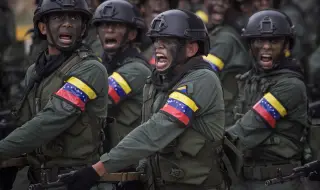
Ugly scenes are unfolding on the high seas: US warships are shelling boats suspected of transporting drugs. Washington and Caracas are mobilizing military units and exchanging warnings.
At first glance, for Washington, the conflict is about intercepting drug trafficking from Venezuela across the high seas to the US. But behind the scenes, there has long been talk that the issue is actually about the political future of Venezuelan President Nicolas Maduro. He and his socialist regime control the world's largest oil fields.
The context of the conflict
"The current conflict between the US and Venezuela is much more than an ideological dispute - it reflects the extreme competition for energy, markets and geopolitical influence in the region," Demian Reger of the "Hans Seidel" Foundation in Caracas told DW.
The tension is not only with the US, but also with Venezuela's neighbor, Guyana, where old disputes are now rekindling.
After large oil fields were discovered in Guyana, the Maduro regime reactivated old claims to territories in Guyana that would give Caracas access to the fields. The Venezuelan president is citing old agreements with the former British colonial power.
The Rise of Guyana
Since 2015, oil production in Guyana has only been moving in one direction: up. "Caracas is pressing its claims, and the United States is providing diplomatic and military support to Guyana, including to protect billions of dollars in investments by American energy companies," says Reger.
So the current US military operation against Venezuela has another effect - to keep the Americans nearby in case of a possible invasion of Guyana, which Maduro is threatening.
The American companies "Exxon Mobil" and "Chevron" operate in Guyana. With their investments, they helped increase the country's oil production to about one million barrels per day.
The decline of Venezuela
While the Maduro regime looks enviously at Guyana for its oil boom, its own industry is in decline. This is primarily due to internal political failures. Venezuela's state-owned oil company PDVSA, once one of the best-organized energy companies in South America, has become an appendage of the socialist rulers.
Instead of qualified specialists, the government was taken over by party activists with no experience in the field. From around 138 million tons in 2013, production has fallen to 34.5 million tons in 2021, with only a slight increase in recent years.
The collapse was accelerated by US sanctions, after the socialists in Venezuela simply ignored their devastating loss in the 2015 parliamentary elections and intensified their repression of the opposition.
The big winner is China
One of the winners in this situation is China. Since US sanctions significantly hinder or even completely block Venezuela's access to the US market, Caracas sells most of its production to China at deep discounts and through a shadowy fleet.
In this way, China receives cheap oil and has already taken steps to secure its oil supplies in the future. According to Venezuelan media reports, Venezuela and the Chinese company China Concord Resources Corp (CCRC) have signed a cooperation agreement. It is planned to build a floating platform that will increase production in some oil fields fivefold - to 60,000 barrels per day - by the end of 2026.
This is possible thanks to a law passed in 2020 that allows foreign companies to invest in Venezuela despite US sanctions.
"From a geopolitical point of view, China pursues two goals: to cover part of its energy needs at a low price and at the same time to circumvent US sanctions policy. This also provides Beijing with the presence it wants in Latin America as a counterweight to Washington," added Reger.
This means that in the future, as long as the sanctions are in force, Venezuela will remain a supplier that has to sell cheaply due to its own isolation. However, if the country regains access to the US or European markets, China could lose influence, as Caracas will be able to sell its oil more profitably.
Maduro is trying to win over Europe
That is precisely why Maduro is trying to win over the Europeans. At the moment, they are only observers, while the world powers the US and China are guaranteeing themselves options in the region.
"How long will Europe obey Washington?", Maduro asked at a press conference in early September, urging Europeans to ignore US sanctions and come to Venezuela. "Here you are free - come and produce, let's continue producing with or without licenses," Maduro urged.
It remains to be seen whether his appeal will be successful. European oil companies such as Repsol of Spain are currently on standby. US sanctions impose severe restrictions on their activities in Venezuela.
But another reason for the Europeans' distancing is Maduro himself: because of his government's serious human rights violations and alleged electoral fraud in 2024.
Author: Tobias Koeffer