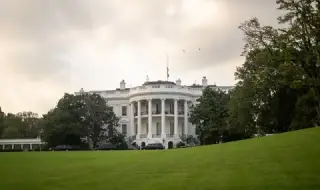
The US federal government has shut down at 12:01 a.m. Washington time tonight after Republicans and Democrats in the Senate failed to agree on funding for ministries and federal agencies. The budget blockade is a leading topic in a number of Western publications.
The US government has shut down for the first time in nearly seven years, threatening hundreds of thousands of jobs and ushering in a new period of uncertainty in President Donald Trump's second term, the "Financial Times" reports. Federal agencies have shut down at midnight Washington time after Republicans and Democrats failed to reach an agreement on funding the federal government for the next fiscal year. Federal agencies are expected to begin large-scale layoffs and curtail public services, plunging Washington into one of the biggest political crises since the start of Trump's second presidential term, the Financial Times also reported.
The shutdown of federal agencies is expected to result in the layoff of about 750,000 employees and the loss of billions of dollars to the American economy, the publication noted.
During this period, the federal government is suspending all "non-essential" functions, while employees whose work is considered "essential", such as active-duty military personnel or federal law enforcement officers, are required to report to work, often without pay, the "Financial Times" explains.
In several votes on Tuesday night, Democrats and Republicans blocked each other's proposals for a temporary budget, the "New York Times" reports.
The Republican bill, which would have extended funding for federal services until November 21, was supported by 55 senators, while 45 voted "against". The texts did not receive the necessary support of 60 votes.
Republican senators, in turn, blocked the Democrats' plan, which provided for an extension of funding until the end of October and an increase in health care spending by more than $ 1 trillion. The votes in favor of this plan were 47, while 53 voted "against", the "New York Times" also writes.
The situation was the same in the votes earlier this month. This highlighted how little progress has been made towards reaching a compromise that could prevent the first government shutdown of 2019, the American publication commented.
In 2019, some government departments shut down for 35 days because Democrats in Congress opposed Trump's demand to allocate funds for building a wall along the southern border, the newspaper recalls.
This time, the dispute is related to the Democrats' insistence on extending the deadline for granting health insurance subsidies for low- and middle-income people. In addition, Democrats want to repeal the cuts to the Medicaid program, which are included in the main financial package of the Republicans, notes the New York Times.
This time, the shutdown of federal agencies could have more serious consequences than in the past, predicts the Wall Street Journal. Trump administration officials said that during this period, it is planned to cut jobs in various government departments. These plans are already being challenged in court, the American publication notes.
The shutdown of federal services could affect the economy in various ways - from non-payment of salaries to hundreds of thousands of federal employees to delays in the publication of important economic indicators. The longer this period lasts, the more severe the blow will be to economic growth and to businesses that rely on the daily functioning of the federal government, adds the "Wall Street Journal".
With the absence of centrists in the Senate, the government shutdown could last a long time, the "Washington Post" headlines.
Republican Senator Lindsey Graham proposed a fairly standard idea for a way out of the impasse: the formation of a special group of senators to decide whether a bill could be drafted that would allow federal agencies to continue operating without affecting the Affordable Care Act.
"They should actually form a task force to solve this problem. Find a solution that we can all live with," Graham told reporters on Monday night, about 30 hours before the federal shutdown.
Despite his status as a veteran of previous Senate "groups" that have resolved disputes, Graham said he does not want to participate in such a task force now. Other veteran senators who have served on similar groups in the past also did not rally as the fight against the federal shutdown raged, the Washington Post noted.
Instead, Senate Majority Leader John Thune (R-South Dakota) and Minority Leader Chuck Schumer (D-New York) were given considerable leeway to implement their strategies for shutting down the federal government and then try to win the ensuing battle for public opinion.
One reason they were given such leeway is that very few senators are subject to the political pressure that usually accompanies crisis events like a federal shutdown, the Washington Post reported. Most senators' seats are secure for now, and the reelection campaigns of many of them are a distant problem, the publication added.
Some veteran centrists want to start negotiations, but for now they are giving way to Thune and Schumer.
"I think there is still a majority of members of both parties who could unite, and I hope that happens," said Senator Jeanne Shaikhin (Democrat of New Hampshire) on Tuesday. According to her, however, there was no real way to avoid a short-term shutdown of federal agencies. "The problem is that no one is negotiating," Shaikhin said, quoted by "The Washington Post".