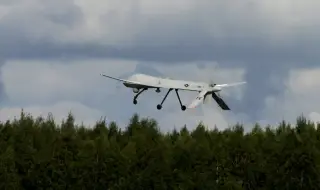
"Latvia is gradually becoming a superpower in the field of drone technologies" - said the country's Defense Minister Andris Spruds on the occasion of the first anniversary of the creation of the “drone coalition“. It now includes 20 countries that invest in the production and supply of unmanned aerial vehicles (UAVs) to Ukraine. Combat tests on the front allow the participating countries to accelerate the improvement of their own developments. Particular attention is paid to the integration of artificial intelligence technologies, which in the coming years may change the nature of combat operations, experts note.
For Latvia, this is becoming particularly relevant. The country borders Russia and lives with a sense of escalating geopolitical tension. On the night of September 10, Russian drones violated Polish airspace, and a few days later, Estonia recorded an unauthorized entry of Russian MiG-31 fighter jets into its airspace. Remains of Russian drones have also been found in Latvia itself.
How the "drone coalition" helps Ukraine
The coalition to support Ukraine with drones was created on February 16, 2024 at the initiative of Latvia. Later, the United Kingdom joined the project, and this year Turkey and Belgium did the same. According to the Latvian Ministry of Defense, since the existence of this coalition, about 100 thousand unmanned aerial vehicles of various types have already been delivered to Ukraine or are being prepared for delivery for about 4.5 billion euros.
The website of the Latvian Ministry of Defense describes in detail the production process: the Ukrainian military formulates the technical requirements for the devices, after which the participating countries begin testing and serial production. Such an approach allows the finished drones to be delivered to the front in the shortest possible time.
The threat is not only for the Baltic countries or Poland
“We cannot produce thousands of tanks, but we can create tens of thousands of drones, which will be no less effective. For a small country, this is a way to strengthen its security asymmetrically“, said the former Minister of Defense of Latvia Artis Pabriks in an interview with DW. It also provides opportunities for economic development, as it involves industry, universities and the military in joint projects, he adds.
Politicians are particularly concerned about Russia's provocative actions - from jamming GPS signals to sending drones over Poland, Romania and the Baltic states. "If the allies are not ready to shoot down these drones in our airspace, Moscow will only increase the pressure. Anyone who thinks that the threat is limited to the Baltic states or Poland - the drones can reach Paris or Berlin, "Pabriks emphasizes. However, he believes that the main problem is “not the lack of technology, but the lack of political will“.
Latvia is developing its own drone production
Latvia's own drone production is still modest: in 2024, about 5,000 units were sent to the Ukrainian front, mainly FPV drones (First Person View - with control from the pilot's perspective). However, the Latvian military department insists that the country is increasing its potential and competing with the big players in the drone industry. In 2026, Riga intends to invest no less than 100 million euros in the development of its own drone production – approximately 6-7% of the country's annual military budget.
Edgars Gauručs, co-founder and CEO of drone manufacturer Eraser, says that flexibility and speed of implementation of new technologies are important elements for production. “A few years ago, drones were perceived as toys or photography equipment, but now they have proven their effectiveness on the battlefield. Small and relatively cheap devices can destroy equipment worth millions. In addition, their production is fast and massive“, he notes.
Latvia is betting on research and development, not just production. “Our drones are tested against electronic warfare, which makes it possible to create more resilient systems. "In Europe, we all need to work together if we want to maintain our technological advantage over Russia and China," says one of the founders of Eraser.
Opportunities and risks for Latvia
Political observer Kristian Rosenvalds considers Latvia's decision to actively develop the unmanned systems sector to be wise. By participating in the "drone coalition", Latvia has a chance to prove itself to its Western partners. However, Latvia's active role in the production and development of the unmanned aircraft industry is not a show of force, Rosenvalds emphasizes: "It is clear that such a small country is inferior to large countries in terms of population and financial capabilities, but it can become an intermediary in finding technological and organizational solutions," he adds.
At the same time, the observer warns that the rapid development of unmanned systems, especially in combination with artificial intelligence (AI), also requires great responsibility: "We ourselves create weapons, and therefore we are obliged to think about how to master them. The history of nuclear weapons since the mid-20th century shows: first comes the race to develop and demonstrate power, and then the world community is forced to develop conventions and control mechanisms. The combination of drones and AI can create similar risks - and that is why it is very important that this ends with concrete international rules, for example, a convention, and not just a technological race,“ Rosenvalds points out.