If the EU decides to use the frozen reserves of the Russian Central Bank to help Ukraine, as the European Commission has planned, the Kremlin will immediately nationalize and sell foreign assets frozen in Russia. This was reported by Bloomberg sources, as well as a number of media outlets close to the Russian government.
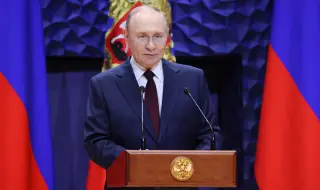
According to Bloomberg, it was precisely for this purpose that Putin signed a decree on September 30 "On Certain Features of the Sale of Property That Is Federal Property". The decree provides for an expedited procedure, and no more than ten days will be allocated for the evaluation of the seized assets. The state bank PSB, which serves the Russian military-industrial complex, will be responsible for the sale. The decree also directly states that the measures are in response to "hostile actions of the United States and other foreign states".
The adoption of the decree was preceded by statements from high-ranking Russian officials. "In the event of confiscation, there will be a response", promised presidential spokesman Dmitry Peskov. He called the EU plans "theft", and Security Council Deputy Chairman Dmitry Medvedev said that those involved in the seizure of Russian property would be prosecuted "until the end of the century".
These Russian reactions were a response to the discussed plan to provide Ukraine with a so-called "reparation loan" in the amount of 140 billion euros, secured by Russian assets frozen in the Belgian depository Euroclear. At the end of September, German Chancellor Merz also spoke in support of this plan.
How many Western companies continue to operate in Russia
There are no reliable estimates of the value of European assets that are threatened with confiscation - there are only indirect data. According to a study conducted in early 2025 by the Kiev School of Economics, in 2023, 827 Western European companies were actively operating in Russia. Their total revenue in the same year amounted to $81.4 billion, and a year earlier - to $111.4 billion. Tax deductions in both years were three billion dollars.
There are no similar studies for 2024 yet, but there are regularly updated lists of companies remaining in Russia. One ("Leave Russia") is compiled by the Kiev School of Economics, and the other by a group of economists led by Yale School of Management professor Jeffrey Sonnenfeld. Their data show that hundreds of companies from Western Europe and the United States continue to operate actively in Russia.
According to "Leave Russia", before the start of the Russian invasion of Ukraine, 459 German companies operated in Russia. 251 of them, according to the list's compilers, continue to operate in the country (for example, Metro, Globus, Ritter Sport), and 134 are in the process of ceasing their operations. Only 74 companies have already left the Russian market. Analysis of the lists shows that after 2023, the process of withdrawing Western business has practically stopped - mainly because the Russian authorities have begun to actively hinder it.
How does this happen? Foreign companies are required to coordinate the sale of assets with the government's Foreign Investment Control Commission. The transaction price must be at least 50 percent lower than the latest valuation of the business. Later, another requirement was added - 10 percent of the transaction price must be transferred to the Russian budget. But even if the owners are ready to sell the business under such conditions, the government commission can still block the deal.
There is also another condition - the responsible department must have no objections. It recently became known that such objections have thwarted another attempt to sell the Russian business of the Raiffeisenbank International financial group. According to Reuters, Moscow is interested in keeping Raiffeisenbank in the country because the bank continues to connect Russia with the European financial system.
What other European property can Russia confiscate
In addition to European companies that continue to operate in Russia, the Kremlin's claims may also extend to the financial assets of foreigners that have been frozen in the country. According to the "New York Times", these are the so-called C-type accounts in which Russia has frozen money and securities of foreign investors. This measure was introduced in response to the freezing of the Russian Central Bank's reserves in the West.
Russia may copy the European strategy - not to confiscate assets, but to use them, for example, as collateral for issuing bonds, the sale of which would allow financing the growing deficit of the Russian state budget. Such an assumption was made to the "New York Times" by Alexander Kolyandr, a researcher at the Center for European Policy Analysis (CEPA).
The volume of funds deposited in type C accounts is unknown. In the spring of 2023, the Central Bank reported that there were about 500 billion rubles in them. Later, the head of the "Investment Financial Intermediaries" department at the Central Bank, Olga Shishlyannikova, said that the total amount of frozen financial assets "significantly" exceeds the funds of Russian private investors blocked in Europe. In total, several tens of billions of dollars may be frozen in the C-type accounts, suggests Alexander Kolyandr.
The fate of frozen Russian assets in the EU has not yet been decided
At the informal meeting of the European Council held in Copenhagen on October 1, the President of the European Commission Ursula von der Leyen first presented the main elements of the proposal to transfer frozen Russian assets to Ukraine.
According to EU representatives, the feedback from the Community countries was constructive, although Belgium, France and Spain expressed reservations. However, the topic will continue to be discussed. It is likely that a specific decision to transfer frozen Russian assets to Ukraine will be submitted for discussion at the official EU meeting on October 23-24 in Brussels.
Author: Oleg Loginov