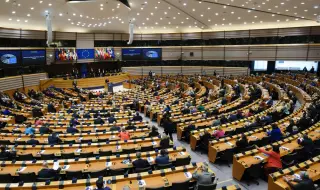
The consideration of two votes of no confidence against the President of the European Commission Ursula von der Leyen will once again test the so-called pro-European majority in the European Parliament in Strasbourg, after more than a year of disagreements, reproaches, criticism and attacks, BTA reported, citing AFP.
The debates on the two votes are today. The vote is on Thursday. The proposals for the two votes came from the far right and the radical left in September. The two votes have almost no chance of succeeding and the President of the EC being ousted.
But they reflect a change in the atmosphere in the European Parliament, whose composition was renewed in the European elections last year, when the far right achieved a breakthrough. The two votes will allow us to assess the state of the coalition between the Social Democrats, the center and the right in the EP.
“The situation is very unstable“, commented centrist Pascal Canfin, who fears that the Social Democrats will eventually slam the door on the coalition. “But is there a better alternative than this alliance? No, we are far from it“, he adds.
The left and the center accuse the European right, represented by Ursula von der Leyen, of maintaining dual ties with the far right in order to better hinder the implementation of environmental laws.
“Tensions will increase even more because the EC is pursuing a right-wing agenda mixed with the far right“, says ecologist David Korman.
The bitterness grew even more this summer after the trade agreement signed by the European Union with the United States, which many MEPs, including supporters of the EC President, describe as unbalanced.
The MEPs returned to the plenary chamber nervous after being bombarded all summer with what a good deal would be concluded with Trump, says a senior European representative.
Von der Leyen defended the agreement, saying it was the best that could be achieved with the US president. She called for unity in the EP on 10 September, stressing the seriousness of the geopolitical situation marked by the war in Ukraine.
But after her speech, the first reaction of the leaders of the two main parties was to attack each other, an EC source regretfully said, referring to the German Manfred Weber and the Spanish Irace Garcia, who are respectively the leaders of the right and the Social Democrats.
On 10 September, Weber fuelled the feud by criticising the Spanish Socialists for their behaviour, which he said was dividing the coalition behind von der Leyen. “Who is responsible for the fact that this pro-European union is not working in this parliament? "There's a name for it, and it's Manfred Weber," Irace Garcia replied.
A source who has been aware of what's happening in the EP for years says that things are developing like in a sandbox, where children compete to outdo each other and relationships between them are flawed.
And while this is happening, the far right is enjoying the spectacle. "We watch it with amusement, we let them solve their marital problems themselves," said MEP Julie Ryoschan, who represents the "Patriots for Europe" group in the European Parliament.
So far, due to the lack of important laws to discuss, these disagreements, which are repeated, remain without major consequences. But autumn will be the moment of truth, warns Manfred Weber.
Because the first major laws are coming, including the series of measures to simplify European environmental legislation, which is dividing the European Parliament.
The left and the center fear that the right and the far right will coordinate to largely bury the environmental measures adopted by the previous EP.
According to a high-ranking representative, the risk is not whether some of the no-confidence votes will pass this time, but that everything revolves around a single text that causes a blockage and leads to divisions in the parliament.
In early July, the European Parliament overwhelmingly rejected a no-confidence vote against Von der Leyen, which was then submitted by the far right. This consideration of three votes of no confidence against the EC President within a few months is something unprecedented in Brussels.
The EP has never brought down a European Commission with a vote of no confidence before.
But there is one special case, dating back to 1999. Before a previously lost vote, the EC, then led by Jacques Santer of Luxembourg, resigned after the publication of a critical report on her heavy responsibility in a fraud affair.